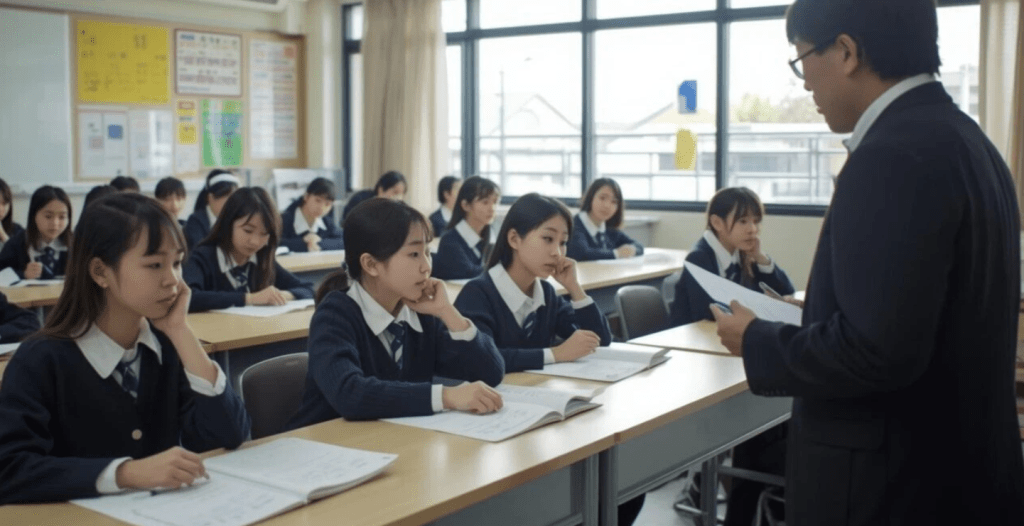
This is TobiraAI, writing from this area. Thank you as always for reading. Please take it easy and relax. Following the previous article, this time we’ll explore the drawbacks of girls’ schools.
Quiz of the day:
Without bias, observe both coeducational and girls’ schools carefully — where can true gender sensitivity be realized?
Part III: Disadvantages of Girls’ Schools
1. Limited Socialization Opportunities
Lack of natural interaction with the opposite sex.
The ACLU and NOW argue that coeducation fosters interpersonal skills between genders. Mendez (2004) warns that “without developing friendly relationships in school, boys and girls cannot grow into adults who understand and respect each other.” Yet, Caplice (1994) counters that other venues—families, communities, churches, and volunteer organizations—also provide opportunities for interaction.
2. Risk of Reinforcing Stereotypes
Tsuruta (1998) points out that single-sex education has historically implanted gendered messages. Hiroi (2022) reveals that prewar female education emphasized domestic roles, rooted in the “trait theory,” which viewed gender differences as natural yet equal, prescribing separate education accordingly.
3. Educational Inequality in Historical Context
The 1901 regulations for girls’ high schools included “home economics” and “sewing,” while boys’ schools taught “law and economics.” Smyth (2010) suggests these historical disparities may still influence modern education.
4. Conflicting Evidence on Academic Performance
Pahlke, Hyde & Allison (2014) found in a meta-analysis of 184 studies that single-sex education does not consistently outperform coeducation. Academic effects are often confounded by factors like selectivity, socioeconomic background, and teacher quality.
5. Limited Accessibility and Choice
Historically, many girls’ schools were private, accessible mainly to affluent families. Riordan (cited in Vail 2002) notes that lack of single-sex options in public schools can disadvantage lower-income or minority students.
Part IV: Modern Perspectives
1. Reevaluation through Gender Studies
Koyama (2009) identifies a dual structure in postwar education: equal access in policy but unequal practice. Hidden curricula in coed schools also perpetuate inequality. Thus, the issue is not binary—single-sex vs coed—but how gender-sensitive education can be realized in both systems.
2. Girls’ Schools as a Voluntary Option
Salomone (quoted in Heise 2004) argues that “in education, separation can be equal when it is voluntary.” Caplice (1994) concludes that the goal is not to replace coed schools but to offer students a full menu of learning environments that best suit their style and comfort.
Academic Conclusion
The history of girls’ schools in Japan reflects both the expansion of educational opportunities for women and the reproduction of gender norms.
Merits include: leadership development, active participation in STEM, liberation from gender roles, academic focus, and self-expression.
Demerits include: limited gender interaction, reinforcement of stereotypes, uncertain academic benefits, and unequal accessibility.
Ultimately, what matters is how each environment promotes gender equality and individual growth, not whether it is single-sex or coeducational.
From an Educator’s Perspective
Many alumnae express high satisfaction with their alma mater. Yet, I often hear parents say, “My daughter must attend a girls’ school.” Such decisions should belong to the student.
I strongly recommend visiting both coed and girls’ schools without bias. Limiting options too early can narrow choices, especially outside metropolitan areas. Observe how each school supports gender-sensitive education — in policies, leadership attitudes, training, uniforms, and facilities.
Key Points
When choosing a school, look for:
- Clear statements on gender equality and diversity
- Leadership committed to non-stereotypical education
- Teacher training on gender and inclusion
- Freedom in uniforms and activities
- Considerate design for diverse gender identities
- Visual balance in posters and campus messages
Ultimately, the answer to today’s quiz is: “Gender-Sensitive Education.”
Thank you for reading — your likes and comments encourage me deeply.
Warm regards,
TobiraAI
 TobiraAI_ A specialist in Education, AI, and History