📝 Summary
True expertise isn’t about how much you know — it’s about how well you apply what you know.
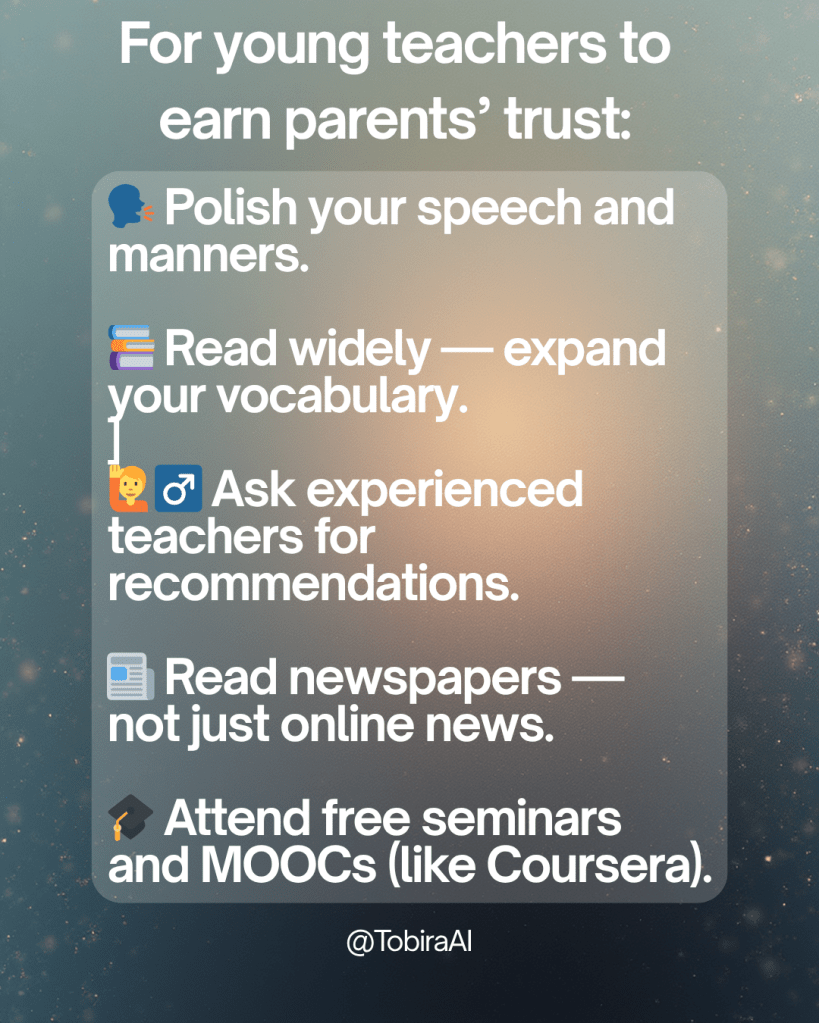
For young teachers, earning parents’ trust starts with gathering, organizing, and demonstrating knowledge in practical ways. Begin by refining your communication — polite, confident speech instantly changes impressions. Then, read books that enrich your language and perspective. Seek guidance from senior teachers, and learn from their experiences.
Keep up with reliable information sources such as newspapers rather than social media feeds. Participate in free seminars and MOOCs to expand your worldview. Most importantly, store what you learn in platforms like NotebookLM and use it — create PowerPoint slides, classroom newsletters, or short presentations.
Knowledge that stays unused fades quickly; knowledge that’s applied becomes your strength.
Even mistakes are allowed when you’re young — what matters is consistent effort and growth.
By transforming what you learn into something visible and useful, you’ll move from being “the young teacher” to “the trusted teacher.”
Full Article
Hello, this is TobiraAI speaking from this area — thank you for reading as always. Please take your time and relax.
Today’s theme is simple yet profound:
Knowledge means nothing unless you use it.
STEP 4: Collect Knowledge Thoroughly
To earn the trust of parents, young teachers must constantly gather and refine knowledge related to education. This includes not only lesson plans or paperwork but also broader insights into communication, psychology, and educational trends. Parents often view young teachers as inexperienced — “Are they really okay?” they may wonder.
That’s why information is your strongest ally. When you demonstrate that you know why something works, parents will trust your judgment.
§1 Polish Your Speech and Manners
A childish tone makes parents uneasy. Observe how senior teachers talk on the phone or in meetings. Copy their phrasing — that’s how professionals learn. Mastering social communication is the foundation of credibility.
§2 Read Books
Reading builds vocabulary and refines thought. In today’s world where everything is “cool” or “awesome,” nuanced language has real value. Choose books that are easy to read yet written by respected authors.
Even one book a month is enough — what matters is consistency. When you find phrases you like, use them in real conversations. Language only grows through use.
§3 Learn from Senior Teachers
To deepen educational knowledge, ask senior teachers for book recommendations. They might suggest classics such as GRIT, StrengthsFinder 2.0, or The Economics of Education. You don’t need to read everything; skim the table of contents and note the key ideas.
When talking with parents, quoting an expert or showing a PowerPoint slide can reinforce your message: “Professor Nakamuro from Keio University also explains this…” — authority builds trust.
The author personally mentions The German General Staff as a book that shaped his thinking — logical, decisive, and action-driven. This mindset can be applied in daily communication with parents: when they ask something uncertain, respond with speed and clarity.
§4 Read the Newspaper
Online news isn’t enough. Newspapers, though old-fashioned, remain the most reliable medium in an era of fake news. Electronic editions are fine, but print avoids “filter bubbles.”
Articles on education can be stored in NotebookLM — it becomes your digital brain. The more you collect, the stronger your knowledge base becomes.
§5 Attend Free Seminars
Many free seminars exist, especially on AI, education, and communication. Japan’s Cabinet Office even declares: “Not using AI is the biggest risk.”
You may encounter promotional pitches at the end — just ignore them unless you’re genuinely interested. Explore event platforms like Peatix; they offer sessions on AI, teaching, and professional growth. Participation expands your horizons.
§6 Take MOOCs
MOOC stands for Massive Open Online Course — free or low-cost, open, online, and structured learning platforms.
Examples include JMOOC, Udemy, Coursera, and Nikkei Business School. JMOOC has accessible Japanese courses; Coursera connects you with top universities worldwide; Udemy focuses on technical and business skills. Even taking one course can spark new perspectives.
Store and Use What You Learn
Simply collecting information isn’t enough. Save articles, insights, and ideas in NotebookLM or similar tools, then use them. Create PowerPoint slides for class meetings or newsletters that reflect what you’ve learned.
When you create something, you connect ideas logically — this process strengthens your brain and builds confidence.
Once you can present your ideas, that knowledge becomes your weapon. Parents will feel, “This teacher is dependable.”
Remember: as a young teacher, mistakes are forgiven. So challenge yourself. Each attempt builds your foundation for lasting trust.
Avoid Becoming a Critic
Don’t just talk about theories — share practical methods parents and students can use right away. The goal is to hear them say, “We’ll try what you suggested.”
Show That You Are Learning
Tell your students what you’re studying or reading. When they see adults who continue learning, it inspires them to do the same. That example is itself a powerful form of education.
Thank you for reading. If you enjoyed this article, please give it a “like” or leave a comment — your feedback is always encouraging.
 TobiraAI_ A specialist in Education, AI, and History