◆300 words English Summary
Teaching is often described as meaningful work, but in reality it is filled with an endless “grind”: grading, paperwork, preparing classes, filling forms, and responding to unexpected problems. Based on the research of Barbara Fredrickson and Laurie Santos, this article explains why these monotonous tasks—far from being meaningless—can become sources of emotional resilience.
“Grindfulness,” a blend of gratitude and mindfulness, invites teachers to dramatically lower the bar for gratitude and to savor micro-positive moments hidden inside daily routines. Research shows that the frequency of small positive emotions predicts long-term well-being. Even brief experiences—a child’s small improvement, a warm cup of cocoa, the sound of laughter—can shift our emotional trajectory when we consciously savor them.
Fredrickson’s Positivity Ratio theory and her Undoing Hypothesis demonstrate how positive emotions actively counteract the physiological effects of stress. This means small joys are not trivial—they are psychological armor.
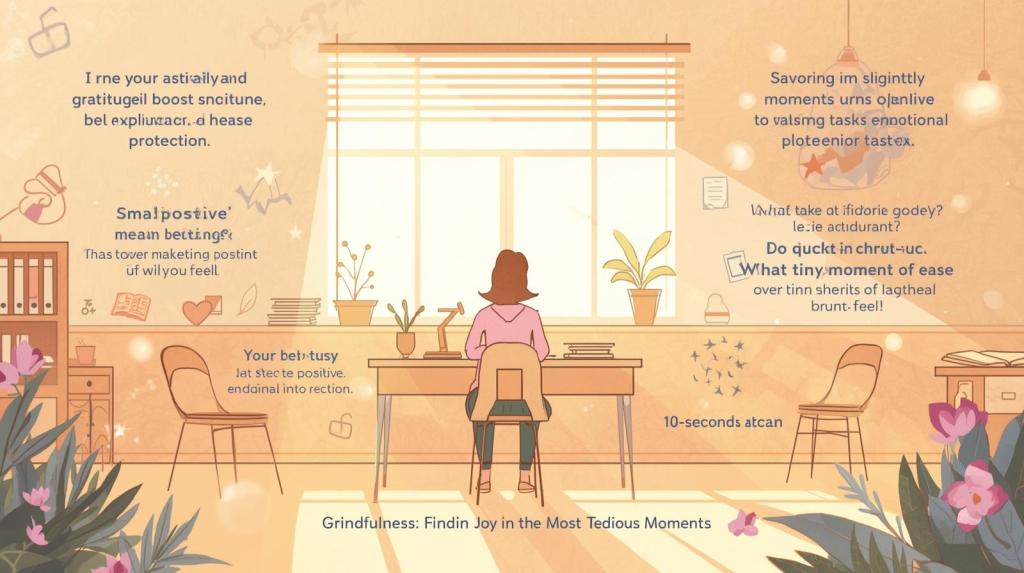
Teachers can begin with a simple “10-second scan” before class:
• What was slightly good today?
• What tiny sign of growth did a student show?
• What moment of ease did I experience?
By noticing one small positive a day, teachers strengthen their resilience and transform ordinary moments into sources of energy.
◆Main Story
It was early autumn in Madison, Wisconsin, the kind of morning where the air carries the smell of damp leaves and fresh coffee. Tom Reynolds, a high-school English teacher, unlocked his classroom as he had done hundreds of times. The fluorescent lights flickered on; stacks of essays waited like silent mountains on his desk. Ordinary life. Routine. The grind.
Tom’s days were filled with the familiar loop—grading, planning, meetings, emails. He didn’t dislike teaching; he just felt worn down by the endless repetition. “If I could just get through this week,” he whispered to himself, a phrase that had become a quiet prayer.
One Tuesday, the conflict arrived in an almost comical form: he accidentally shredded a stack of financial forms that parents had spent hours filling out. His stomach dropped. A parent frowned at him and said, “Please… don’t use the shredder next time.” The words stung more than he expected.
The tension stayed with him for days. He lay awake at night replaying the mistake, feeling the weight of being “a tired teacher who keeps messing up.” His stress pulsed like a tight band around his chest.
So Tom tried something new—a suggestion he had read in an article about “grindfulness.” Before first period, he paused for ten seconds and asked himself: What is one small good thing right now?
The first day, he noticed a student quietly humming while organizing colored pens. The next, he caught the warm smell of the custodian’s early-morning coffee drifting into the hall. Later that week, he saw a subtle but real improvement in a struggling student’s handwriting.
These moments were tiny—almost invisible—but Tom treated them as treasures. He savored them the way one holds a warm mug in both hands. And little by little, the stress softened. His heart stopped racing so easily. The grind didn’t change, but his relationship with it did.
By the end of the semester, Tom felt lighter, steadier. The routine was still demanding, but he realized something important: small joys didn’t merely make bad days tolerable—they actively repaired him. “I learned that resilience isn’t built in breakthroughs,” he reflected. “It’s built in seconds.”
ウィスコンシン州マディソンの初秋の朝。湿った木の葉と淹れたてのコーヒーの香りが入り混じる、少しひんやりした空気が流れていた。その朝も、トム・レイノルズはいつも通り高校の教室の鍵を開けた。蛍光灯がちらつきながらつき、机には山積みのエッセイが静かな山脈のように積まれている。
――これがいつもの日常。これが“グラインド(the grind)”。
トムの日々は、採点、授業準備、会議、メール……同じループの繰り返しだった。教師の仕事が嫌いなわけじゃない。ただ、終わりのない単調さに少しずつ心が削られていた。「この一週間だけでも乗り越えられたら…」それが、最近の彼の口癖のようになっていた。
そんなある火曜日、事件は予想外の形で訪れた。
保護者が時間をかけて記入した大切な書類を、トムは誤ってシュレッダーにかけてしまったのだ。
心臓が凍った。
ある保護者は苦い顔で言った。
「どうか…次からはシュレッダーを使わないでくださいね」
その言葉はトムの胸に想像以上に深く刺さった。
しばらくの間、その緊張はトムの心から離れなかった。夜ベッドに横になっても、ミスを思い出してはため息を漏らし、「自分はダメな教師なんじゃないか」という声が頭の奥でささやいた。胸のあたりがずっと重かった。
そんなとき、トムはある記事で読んだ“グラインドフルネス”という言葉を思い出した。
――毎日の中にある「小さなよいこと」を、10秒だけ探す。
半信半疑だったが、試してみることにした。
翌朝、1限が始まる前。
トムは深呼吸し、自分に問いかけた。
「今、わずかでも良いことは?」
その日の答えは、前の席の生徒がカラーペンを並べながら小さく鼻歌を歌っていたことだった。
次の日は、廊下を歩いていたときに、用務員さんが淹れたコーヒーの香りがほんのり漂ってきたことに気づいた。
また別の日は、苦手だった生徒の字が、前より少しだけ整っていた。
どれも、本当に小さなことだった。
けれど、トムはそれを宝物のように扱った。
まるで両手で温かいマグカップを包み込むように、その瞬間を「味わった」。
すると、少しずつ変化が訪れた。
張りつめていた胸の苦しさが和らぎ、ストレスが以前ほど体に溜まらなくなった。
毎日のルーティンそのものは変わらなかったが、見え方が変わった。
学期が終わる頃、トムは気づいたのだ。
――小さな喜びは、“ただの気分転換”ではない。
それは傷ついた心を修復する、静かな力なのだと。
「レジリエンスって、劇的な変化で生まれるんじゃない。
たった数秒の積み重ねで育つんだ。」
トムはそう静かに理解した。
 TobiraAI_ A specialist in Education, AI, and History