【Body】Estimated reading time: 8 minutes.
Can You Imagine the Pain of Scissors?
If you are right-handed, have you ever stopped to imagine the physical pain of using scissors? The metal handle digging into your thumb, the blades obscuring the line you are trying to cut, the paper bending instead of slicing? Hello, this is Tobira AI.
Today, drawing on the essential insights from the University of Colorado System’s lectures on Coursera, we are going to inspect the contents of the “invisible knapsack” called “Privilege” that we all carry, often without realizing it. In our previous discussion, we covered basic LGBTQ+ terminology based on reports from the Harvard School of Medicine. Today, however, we move from terminology to the raw reality of the classroom. We will explore how the world is designed for the majority, and what that design does to those who do not fit the mold.
Who is “Understanding” Really For?
In the modern society we live in, not a day goes by without hearing the word “Diversity.” Corporate websites, school pamphlets, politicians’ speeches—everywhere you look, the world is painted in rainbow colors. “We welcome everyone,” they say. However, I want to pause here and ask a difficult question: Is that “understanding” genuinely reaching the people who need it, or is it merely self-satisfaction for the majority?
The harsh reality is that the “majority,” those who live their lives without systemic friction, are the ones most likely to miss the “inconvenience” others face. Let me share a personal example. I have color blindness. It is difficult for me to distinguish between red and brown, or between light blue and pink. People who do not understand this feeling are not being malicious or cold. They simply haven’t noticed their own “Visual Privilege”—the ability to see colors clearly without effort. Unlike me, they don’t have to guess if the traffic light is red or if the meat is cooked.
Yes, being able to distinguish red from brown is a privilege. Today, we are going to open up this invisible knapsack. It might be a bit painful to hear, but please stay with me. Acknowledging this discomfort is the first step to creating true “psychological safety” in our schools and workplaces.
The Reality of the Classroom: Why 40% Attempt Suicide
First, let us look at the cold, hard data from the United States. According to comprehensive surveys by GLSEN (Gay, Lesbian & Straight Education Network) and the U.S. Transgender Survey (USTS), the educational environment for sexual minorities is far from a sanctuary.
- Unsafe Schools: About 60% of LGBTQ+ students feel “unsafe” at school specifically because of their sexual orientation.
- Harassment: More than half of transgender students have experienced verbal harassment.
- Physical Violence: Shockingly, 1 in 4 has experienced physical assault within school grounds.
- The Ultimate Cost: Most devastatingly, data indicates that 40% of these students have attempted suicide at least once in their lives. This is approximately nine times the rate of the general population.
Please do not think this is only an American problem. In Japan and other nations, similar tragedies are occurring, often hidden beneath the surface of “cultural harmony.”
The “Right-Handed” World and the True Nature of Privilege
Why is such immense pain left unattended? Why do schools remain dangerous? It is because we, the majority, are largely unaware of our “Privilege.”
When we use the word “Privilege” in this context, it does not mean being a millionaire, having political power, or being an elite. It refers to a specific sociological concept: “Benefits obtained without effort, requiring no labor, simply by belonging to a specific social group.”
The lecture introduces a brilliant analogy: “Right-Handed Privilege.” If you are right-handed, consider this:
- Do you have to cross your arms awkwardly when passing through an automated ticket gate?
- Do you get frustrated with the soup ladle at a salad bar because the spout is on the wrong side?
- Do spiral notebooks dig into your hand when you write?
Most people would answer “No.” Why? Because this society is designed with “Right-Handedness” as the standard (default). Right-handed people do not wake up feeling “proud to be right-handed.” They just live normally, and the world fits them perfectly. Tools work, doors open, and scissors cut. This seamless existence is “Privilege.”
The Cruelty of “Just Try Harder”
Now, imagine a left-handed person complains, “These scissors hurt my hand.” If a right-handed person responded, “You’re just not trying hard enough,” “Being left-handed is all in your mind,” or “You’re being selfish,” how would that sound? It would be cruel, ignorant, and completely lacking in empathy.
Yet, are we not doing exactly the same thing regarding “Cisgender Privilege” (people whose gender identity matches the sex they were assigned at birth)?
- Restroom Anxiety: Have you ever felt terrified that your gender might be questioned or inspected when entering a public restroom?
- ID Humiliation: Have you ever worried about being insulted or detained because of a gap between your photo and your current appearance when showing an ID?
- Media Representation: Have you ever been deeply hurt because people with your attributes are always portrayed as “laughing stocks,” “villains,” or “tragic victims” in TV and movies?
We, as cisgender people, can live our entire lives without worrying about these things. That is “Cisgender Privilege.” The problem isn’t that we have it; the problem is that we don’t see it, and thus we invalidate the pain of those who don’t have it.
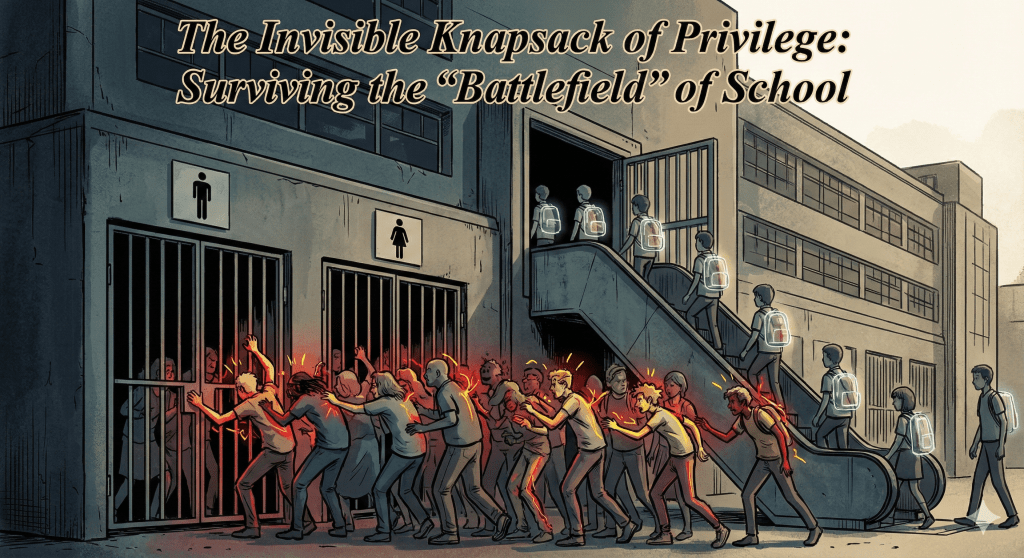
The Bathroom: A Battleground for Survival
Let’s zoom in on one specific “battleground”: the bathroom. Jacob McWilliams (a transgender man), Director of the Women & Gender Center at the University of Colorado Denver, asserts that public restrooms are often the “worst” places for transgender people—zones of potential harassment and violence.
The statistics he cites are alarming:
- Avoidance: In the past year, 59% of transgender people avoided using public restrooms entirely.
- Health Impact: 32% restricted their food and drink intake specifically to avoid needing the restroom.
- Medical Consequences: As a direct result of “holding it,” 8% suffered medical issues such as kidney infections or urinary tract infections (UTIs).
This is no longer a matter of “politeness” or “political correctness.” This is a matter of Public Health and Basic Human Rights. When a student cannot drink water because they are afraid to pee at school, the school has failed in its most basic duty of care.
Schools as “Gender Police”
How does this “unconscious privilege” manifest in educational settings? The lecture uses the concept of “Gender Policing.”
Schools often operate on systems that enforce a strict binary (Man or Woman).
- Spaces where only “Men’s Restroom / Women’s Restroom” exist.
- Roll calls that separate boys and girls.
- Uniform regulations that dictate “Pants for boys, skirts for girls.”
For cisgender people, these are just “rules” or “traditions.” But for transgender and non-binary people, they are a form of structural violence. It is a daily loyalty test that says, “You do not exist,” or “Pick a side, or else.”
Because of safety concerns, data shows that about 35% of affected students have “missed school for at least one day in the past month.” They cannot go to school; they cannot concentrate on classes. Consequently, their GPA drops, and opportunities for college and careers are lost. If educators dismiss this as “lack of effort” or “academic ability issues,” they are complicit in discrimination. Their academic underperformance is not a lack of talent; it is the result of “exhausting their mental energy just to survive in a battlefield-like environment.”
Moving From Sympathy to Structural Change
Reading this far, some of you might think, “How pitiful, I want to save them.” Stop right there. What this lecture demands is not condescending “Sympathy” from above. We do not need to “save” them from themselves.
We need a shift to a “Resource-Based Approach.” Traditionally, education has viewed minority backgrounds as “deficits to be overcome”—handicaps that need to be fixed so the student can be “normal.” The University of Colorado lecture proposes the opposite: Their identities and experiences are “Valuable Assets (Resources)” for education and organizations.
The resilience required to navigate a hostile world, the diverse perspectives on social structures, the creativity to question existing frameworks—these are treasures that enrich the entire organization. We must not ask, “How do we fix these students?” We must ask, “How do we fix this defective system (our ‘right-handed only’ society) that prevents them from using their power?” Change the subject of the sentence. It is not “their” problem; it is “our system’s” problem.
Bridging to the Next Step: From Ally to Accomplice
We have started from terminology, looked at the harsh reality shown by data, and examined the “Privilege” we unconsciously enjoy. The daily life we doubtlessly think of as “normal” is a “wall threatening survival” for someone else. Everything starts with recognizing this fact, along with the pain.
However, merely recognizing it does not change the world. “So, what specifically should we do?” “There is no budget to renovate the toilets.” “The school board doesn’t understand.” Real-world walls will stand in your way.
Therefore, in the next article, we will step into practical actions. The keyword is the evolution from “Ally” to “Accomplice.” What does it mean to step down from the safe cheering section of simply saying “I support you” and become an “Accomplice” who risks their own standing to dismantle the structure? From pronoun usage to policy formulation and “Culturally Sustaining Pedagogy,” I will share strategies to turn your good intentions into tangible power for change.
See you in the next lecture.
【日本語要約】 右利きの人がハサミの使いにくさを感じないように、マジョリティは自身が持つ「特権」に無自覚です。本記事では、University of Coloradoの講義に基づき、学校が「右利き(シスジェンダー)仕様」で作られている現状を解説します。データによれば、LGBTQ+生徒の約6割が学校を安全と感じず、40%が自殺を試みています。特にトイレの問題は深刻で、多くの当事者が飲食を制限し、健康被害を受けています。これは単なる配慮の問題ではなく、生存権の問題です。教育者に必要なのは、彼らを「かわいそうな存在(同情)」として見るのではなく、そのレジリエンスを「貴重な資産(リソース)」として捉え直し、彼らが能力を発揮できない「システム側の欠陥」を修正することです。
【简体中文摘要】 正如右撇子感觉不到剪刀的难用一样,多数群体往往对自己拥有的“特权”毫无察觉。本文基于科罗拉多大学的讲座,阐述了学校环境是如何仅为“顺性别者(Cisgender)”设计的。数据显示,约60%的LGBTQ+学生在校感到不安全,40%曾尝试自杀。特别是厕所问题尤为严重,许多学生为了避免使用厕所而限制饮食,导致健康受损。这不仅是关怀的问题,更是生存权的问题。教育者不应以居高临下的“同情”看待他们,而应将其坚韧不拔的精神视为“宝贵的资产(资源)”,并致力于修正那个让学生无法发挥潜能的“系统性缺陷”。
【한국어 요약】 오른손잡이가 가위를 쓸 때 불편함을 느끼지 못하듯, 주류 집단은 자신이 가진 ‘특권’을 자각하지 못합니다. 본 글은 콜로라도 대학교의 강의를 바탕으로, 학교가 철저히 ‘시스젠더(비트랜스젠더)’ 중심으로 설계된 현실을 지적합니다. 통계에 따르면 LGBTQ+ 학생의 약 60%가 학교를 안전하지 않다고 느끼며, 40%가 자살을 시도합니다. 특히 화장실 문제는 심각하여, 많은 당사자가 화장실 이용을 피하려 음식 섭취를 제한하고 건강을 해치고 있습니다. 이는 단순한 배려가 아닌 생존권의 문제입니다. 교육자에게 필요한 것은 그들을 동정하는 것이 아니라, 그들의 회복탄력성을 ‘귀중한 자산(리소스)’으로 인식하고, 그들이 능력을 발휘할 수 없게 만드는 ‘시스템의 결함’을 수정하는 것입니다.
【Résumé en français】 Tout comme les droitiers n’imaginent pas la douleur d’utiliser des ciseaux de la main gauche, la majorité est souvent inconsciente de ses “privilèges”. Basé sur un cours de l’Université du Colorado, cet article examine comment les écoles sont conçues par défaut pour les personnes cisgenres. Les données sont alarmantes : 60 % des étudiants LGBTQ+ ne se sentent pas en sécurité à l’école et 40 % ont tenté de se suicider. La question des toilettes est critique ; beaucoup limitent leur consommation d’eau pour les éviter, causant des problèmes médicaux. Ce n’est pas une question de politesse, mais de santé publique. Les éducateurs ne doivent pas offrir de la “sympathie”, mais adopter une approche basée sur les ressources, reconnaissant la résilience de ces étudiants comme un atout et corrigeant le système défectueux qui les marginalise.
【Deutsche Zusammenfassung】 So wie Rechtshänder den Schmerz beim Benutzen einer Schere nicht spüren, ist sich die Mehrheit ihrer „Privilegien“ oft nicht bewusst. Basierend auf Vorlesungen der University of Colorado beleuchtet dieser Artikel, wie Schulen standardmäßig für Cisgender konzipiert sind. Daten zeigen: 60 % der LGBTQ+-Schüler fühlen sich in der Schule unsicher, 40 % haben einen Suizidversuch unternommen. Besonders kritisch ist die Toilettensituation; viele schränken Essen und Trinken ein, um Toiletten zu meiden, was zu Gesundheitsschäden führt. Dies ist keine Frage der Höflichkeit, sondern des Existenzrechts. Pädagogen sollten kein Mitleid zeigen, sondern die Resilienz dieser Schüler als „wertvolle Ressource“ betrachten und die strukturellen Defekte des Systems beheben, die ihre Entfaltung behindern.
【Versión en español】 Al igual que los diestros no sienten el dolor de usar tijeras, la mayoría desconoce sus “privilegios”. Basado en conferencias de la Universidad de Colorado, este artículo expone cómo las escuelas están diseñadas para personas cisgénero. Los datos revelan que el 60% de los estudiantes LGBTQ+ se sienten inseguros en la escuela y el 40% ha intentado suicidarse. El problema de los baños es crítico: muchos limitan su ingesta de alimentos y líquidos para evitarlos, sufriendo daños a la salud. No es cuestión de cortesía, sino de derechos humanos. Los educadores no deben sentir “simpatía”, sino adoptar un enfoque basado en recursos, valorando la resiliencia de estos estudiantes como un activo y corrigiendo el sistema defectuoso que los oprime.
【Suomenkielinen yhteenveto】 Aivan kuten oikeakätiset eivät tunne kipua käyttäessään saksia, enemmistö on usein tietämätön “etuoikeuksistaan”. Coloradon yliopiston luentojen pohjalta tässä artikkelissa tarkastellaan, kuinka koulut on suunniteltu oletusarvoisesti cis-sukupuolisille. Tilastot ovat hälyttäviä: 60 % LGBTQ+-opiskelijoista tuntee olonsa turvattomaksi koulussa ja 40 % on yrittänyt itsemurhaa. WC-tilat ovat kriittinen ongelma; monet rajoittavat syömistä ja juomista välttääkseen niitä, mikä johtaa terveysongelmiin. Kyse ei ole kohteliaisuudesta, vaan eloonjäämisestä. Kasvattajien ei tule tarjota sääliä, vaan nähdä näiden oppilaiden selviytymiskyky “arvokkaana resurssina” ja korjata viallinen järjestelmä, joka estää heitä menestymästä.
【हिंदी सारांश】 जैसे दाएं हाथ के लोग कैंची का उपयोग करते समय दर्द महसूस नहीं करते, वैसे ही बहुसंख्यक समाज अपने “विशेषाधिकारों” (Privilege) के प्रति अनजान रहता है। यूनिवर्सिटी ऑफ कोलो라도 के व्याख्यान पर आधारित यह लेख बताता है कि कैसे स्कूल केवल “सिसजेंडर” (Cisgender) लोगों के लिए डिज़ाइन किए गए हैं। आँकड़े बताते हैं कि 60% LGBTQ+ छात्र स्कूल में असुरक्षित महसूस करते हैं और 40% ने आत्महत्या का प्रयास किया है। शौचालयों की समस्या गंभीर है; कई छात्र इनका उपयोग न करने के लिए खाना-पीना कम कर देते हैं, जिससे स्वास्थ्य खराब होता है। यह केवल शिष्टाचार नहीं, बल्कि जीवन के अधिकार का मुद्दा है। शिक्षकों को चाहिए कि वे छात्रों के प्रति “सहानुभूति” दिखाने के बजाय, उनकी सहनशक्ति को “बहुमूल्य संपत्ति” मानें और उस दोषपूर्ण प्रणाली को सुधारें जो उनकी क्षमता को रोकती है।
 TobiraAI_ A specialist in Education, AI, and History