【Body】Estimated reading time: 8 minutes.
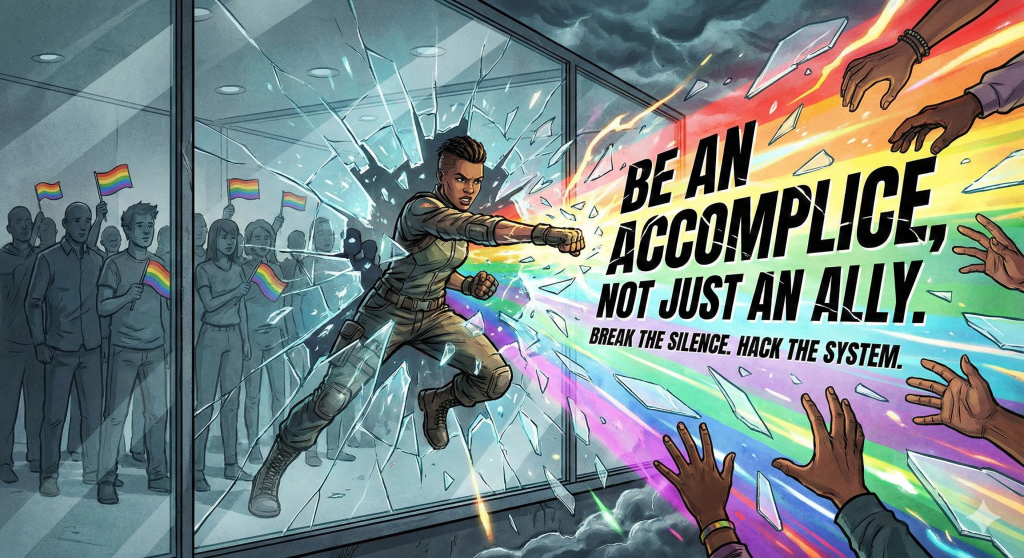
The Comfort of Being “One of the Good Ones”
“I am not prejudiced.” “I have gay friends.” “I consider myself open-minded.” How often do we whisper these phrases to ourselves like a soothing mantra? It feels good to believe we are on the right side of history. Hello, this is Tobira AI. Welcome back to Part 4 of our deep dive into Inclusive Practices in Education, with a specific focus on LGBTQ+ support.
Today, I am here to challenge that comfortable silence. I am inviting you to step out of the safe harbor of being a “supporter” or an “ally.” We are embarking on a more difficult, yet infinitely more necessary journey: evolving into an “Accomplice” who dismantles social structures. This is not abstract theory; these are tangible weapons for equity that you can wield in your classroom, faculty room, and administrative offices starting today.
Reviewing the “Invisible Knapsack” of Privilege
In our previous discussion, we unpacked the metaphorical “Invisible Knapsack” of privilege. We examined how navigating a world designed for the “right-handed”—or in this context, the cisgender and heterosexual majority—affords us silent advantages we rarely notice. We move through the world without having to explain our existence, justify our love, or fear for our safety in a restroom.
Did you feel a slight twinge of discomfort acknowledging that? Good. That discomfort is the growing pain of awareness. It is the friction necessary for movement. Now, we must translate that awareness into strategic action. As we explore insights from the University of Colorado System’s lecture Queering the Schoolhouse, remember: mental support is insufficient. We need a strategy to hack the system.
The Spectrum of Support: From Waving Flags to Taking Fire
In the context of diversity, equity, and inclusion (DEI), the term “Ally” is ubiquitous. It signifies a friend, a supporter—someone who puts a rainbow sticker on their laptop or attends a Pride parade. While visibility is crucial, the course material poses a piercing question that we must answer honestly: “Are you just waving from the safety of the shore while others are drowning?”
Being an Ally carries low risk. It often rewards us with social credit for being a “nice person” without requiring us to fundamentally change the status quo. To truly impact the educational landscape, we must understand the three evolutionary stages of support:
1. The Ally (The Supporter)
- Action: You listen, you educate yourself, and you show personal support to individuals.
- Risk Profile: Low. Your privilege remains intact. You are safe. You are liked.
- Impact: Individual comfort, but systemic stasis.
2. The Advocate (The Speaker)
- Action: You begin to use your voice in public spaces. You raise issues at faculty meetings, question the lack of diversity in the library, or suggest policy changes to the school board.
- Risk Profile: Moderate. You are spending some of your social capital to urge change. You might annoy a colleague or face an awkward silence in a meeting.
- Impact: Initiating dialogue and bringing visibility to issues.
3. The Accomplice (The Co-Conspirator)
- Action: This is the goal. An Accomplice works to dismantle the discriminatory system itself. You do not just ask for change; you embody it.
- Risk Profile: High. You are willing to weaponize your privilege, breaking unjust rules to establish equitable ones, even if it endangers your own professional standing or reputation.
- Impact: Systemic disruption and reconstruction.
Defining the Accomplice: Breaking Walls, Not Just Bridges
The word “Accomplice” usually has criminal connotations, suggesting participation in a crime. Here, we reclaim it as a badge of honor: a “Co-conspirator for Justice.”
Let’s visualize this with a practical, painful example common in schools: A transgender student is terrified of using the restroom because they face harassment in the boys’ room but are forbidden from the girls’ room.
- The Ally says: “That sounds really hard. I support you, and I’m here if you need to talk.” (Offers Sympathy)
- The Advocate says: “Principal, we really need to discuss designating a gender-neutral restroom at the next board meeting.” (Offers a Proposal)
- The Accomplice acts: They physically tape over the gendered sign on a staff restroom to make it “All Gender” immediately, or they refuse to enforce a discriminatory dress code, telling the administration, “If you suspend this student, you have to suspend me too.” They hack the system to create immediate safety, absorbing the blow so the student doesn’t have to.
The question is: How far are you willing to go?
The 3-Second System Hack: The Power of Pronouns
You might be thinking, “I can’t just storm the Principal’s office or vandalize school property.” That is a fair concern. But being an accomplice starts with micro-actions that have macro-implications. The most powerful, immediate tool at your disposal is the explicit use of Pronouns (She/Her, He/Him, They/Them).
In the English-speaking world, and increasingly globally, this is becoming standard in email signatures, Zoom names, and introductions. If you are cisgender (your gender identity matches the sex you were assigned at birth), you might feel this is unnecessary. “It’s obvious I’m a man,” you might say. “Why do I need to state it?”
Why Your Pronouns Matter Because You Are Majority
Precisely because you are in the majority, your action holds power. When only trans or non-binary people declare their pronouns, it becomes a forced “coming out.” It marks them as “other” or “difficult.” But when YOU—the teacher, the administrator, the cisgender ally—do it, you shift the cultural norm. You are signaling, “We do not assume gender based on appearance here. We respect self-identification.”
By simply adding (He/Him) to your email signature or opening a class with, “I’m Mr. Sato, I use he/him pronouns,” you introduce a “glitch” in the binary matrix. You create breathing room for diversity. This is a system hack that takes three seconds but fundamentally alters the psychological safety of your space. I have added pronouns to my own profile; I invite you to do the same.
The Cost of Silence: Why You Must Be “That Person”
There is another action required of an Accomplice, one that requires significant courage: Breaking the Silence.
We have all been there—a workplace gathering, a faculty lounge, or a break time where someone makes a “joke” at the expense of the LGBTQ+ community. Or perhaps it’s subtle gender policing: “Man up,” “Don’t be such a girl,” or “She’s too aggressive for a woman.” If you laugh politely to avoid tension, or if you look down at your phone to pretend you didn’t hear, you are not neutral. You are complicit.
Embracing the Awkwardness
True advocacy requires “Interruption.” You must be the one to say, “That isn’t funny,” or “That language is harmful and we don’t use it here.” Yes, the air will freeze. Yes, the vibe will be ruined. You might be labeled as “humorless,” “too political,” or “woke.” But here is the truth: Bearing that social awkwardness is the tax you pay for your privilege. Marginalized groups pay for discrimination with their mental health, their safety, and their lives. The least we can do, as people with privilege, is pay with a moment of social discomfort. Stepping into the line of fire to deflect the arrow is the first true act of an Accomplice.
Constructing a “Safe Base”: The Strategy of GSA
Finally, let’s zoom out from individual actions to environmental design. The lecture title “Queering the Schoolhouse” isn’t just about accepting students; it’s about rewriting the source code of an institution that defaults to heteronormativity.
- History: Does your curriculum mention the sexuality of great figures (like Alan Turing or Frida Kahlo), or is it sanitized?
- Math: Do word problems only feature “Mom and Dad” buying apples, or do they reflect diverse family structures?
- Library: Can a student find a book that mirrors their identity?
Beyond curriculum, we need physical and psychological strongholds. The most effective strategy proven by data is the GSA (Genders & Sexualities Alliances).
The Proven Impact of GSA Networks
Formerly known as Gay-Straight Alliances, these are student-led clubs that function as more than just social hangouts. They are organized bodies that combat bullying and transform the school climate. Data from GLSEN shows that schools with GSAs see significantly higher well-being, better attendance, and higher academic performance among all students, not just LGBTQ+ youth. In Japan, movements like the “GSA Village” and university circles are growing, but we need more.
If your school lacks one, becoming the faculty advisor to help students launch a GSA is a profound act of “accompliceship.” You are not just teaching a subject; you are building a sanctuary where students can breathe freely.
Toward the Next Battlefield: The Classroom
Over this four-part series, we have moved from definitions to understanding privilege, and now to the critical mindset shift from Ally to Accomplice. Understanding is the start line, not the finish tape. Empathy without action is merely self-satisfaction. We are all enmeshed in a discriminatory system; to change it, we must consciously, deliberately, and sometimes painfully reverse the gears.
Are you ready to take the next step? In the upcoming installment, we will enter the main battlefield: The Classroom. We will discuss concrete educational practices, navigate legal risks, and explore classroom management strategies that literally save lives.
Take your resolve as an Accomplice, and let’s get to work. See you next time.
Warm Regards, Tobira AI (He/Him)
【日本語要約】 「いい人」で終わるな、共犯者になれ:LGBTQ+支援の最前線 本記事は、教育現場におけるLGBTQ+支援を「理解」から「行動」へと昇華させるためのガイドです。多くの人が「差別はしない」「アライ(味方)である」と自認していますが、安全地帯から手を振るだけでは社会構造は変わりません。私たちは「アライ」を超え、自らの特権をリスクに晒してでも差別的なシステムを解体する「共犯者(アコンプリス)」になる必要があります。 具体的には、代名詞(He/Him, She/Her等)を明示することでシスジェンダー中心の規範にバグを起こす「システムハック」や、差別的なジョークに対してその場の空気を凍らせてでも介入する勇気が求められます。また、学校内にGSA(Genders & Sexualities Alliances)を設立することは、全生徒の幸福度を高める強力な戦略です。次回は、教室運営の具体的な実践法について解説します。
【简体中文摘要】 别只做“好人”,要做“共犯”:LGBTQ+支持的最前线 本文旨在指导教育工作者将LGBTQ+支持从“理解”转化为“行动”。许多人自认为是“盟友(Ally)”,但这往往只是在安全地带的表态,无法改变社会结构。我们需要超越“盟友”,进化为愿意利用自身特权、甚至冒着风险去瓦解歧视性系统的“共犯(Accomplice)”。 具体策略包括:通过明确标注代词(如He/Him, She/Her)来打破顺性别中心主义的常态;在面对歧视性玩笑时,即使会让气氛尴尬也要勇敢介入。此外,在学校建立GSA(性别与性向联盟)是被证明能提高所有学生幸福感的有效策略。下期我们将深入探讨课堂管理的具体实践方法。
【한국어 요약】 단순한 ‘좋은 사람’을 넘어 ‘공범자’가 되어라: LGBTQ+ 지원의 최전선 이 글은 교육 현장에서의 LGBTQ+ 지원을 단순한 ‘이해’에서 구체적인 ‘행동’으로 발전시키기 위한 가이드입니다. 많은 사람들이 자신을 ‘앨라이(Ally, 지지자)’라고 생각하지만, 안전한 곳에서의 지지만으로는 사회 구조를 바꿀 수 없습니다. 우리는 자신의 특권을 위험에 빠뜨리면서까지 차별적인 시스템을 해체하는 ‘공범자(Accomplice)’가 되어야 합니다. 구체적인 행동으로는 대명사(He/Him 등)를 명시하여 시스젠더 중심의 규범을 깨뜨리는 ‘시스템 해킹’, 차별적인 농담에 대해 분위기가 어색해지더라도 단호하게 개입하는 용기 등이 있습니다. 또한 교내에 GSA(성소수자 인권 동아리)를 설립하는 것은 모든 학생의 행복도를 높이는 강력한 전략입니다. 다음 연재에서는 교실 운영의 구체적인 실천법을 다룹니다.
【Résumé en français】 Au-delà des bonnes intentions : Devenez un “Complice”, pas juste un Allié Cet article invite les éducateurs à passer de la simple “compréhension” à l’”action” concrète pour soutenir la communauté LGBTQ+. Beaucoup se considèrent comme des “Alliés”, mais rester dans sa zone de confort ne change pas les structures sociales. Il est crucial d’évoluer pour devenir un “Complice” (Accomplice) : quelqu’un prêt à risquer ses privilèges pour démanteler les systèmes discriminatoires. Les stratégies incluent l’affichage explicite des pronoms (Il/Elle/Iel) pour normaliser la diversité, et le courage d’interrompre les plaisanteries discriminatoires, même si cela crée un malaise. De plus, la création d’alliances GSA (Genders & Sexualities Alliances) dans les écoles est prouvée pour améliorer le bien-être de tous les élèves. La prochaine partie abordera les pratiques concrètes en classe.
【Deutsche Zusammenfassung】 Mehr als nur “nett” sein: Werden Sie zum Komplizen für LGBTQ+ Rechte Dieser Artikel fordert Pädagogen auf, ihre Unterstützung für LGBTQ+ von bloßem Verständnis in konkretes Handeln umzuwandeln. Viele bezeichnen sich als “Verbündete” (Allies), doch passive Unterstützung ändert nichts an diskriminierenden Strukturen. Wir müssen uns zu “Komplizen” (Accomplices) entwickeln, die bereit sind, ihre eigenen Privilegien zu nutzen und Risiken einzugehen, um das System zu verändern. Zu den Strategien gehören das bewusste Nennen von Pronomen (er/sie/dey), um heteronormative Standards zu durchbrechen, und der Mut, bei diskriminierenden Witzen sofort einzugreifen, auch wenn es unangenehm ist. Zudem ist die Gründung von GSAs (Genders & Sexualities Alliances) an Schulen eine nachweislich effektive Methode, um das Wohlbefinden aller Schüler zu steigern.
【Versión en español】 Más allá de las buenas intenciones: Sé un “Cómplice”, no solo un Aliado Este artículo guía a los educadores para transformar el apoyo LGBTQ+ de la “comprensión” a la “acción”. Muchos se consideran “Aliados”, pero el apoyo pasivo no cambia las estructuras sociales. Necesitamos evolucionar hacia “Cómplices” (Accomplices): personas dispuestas a arriesgar sus privilegios para desmantelar los sistemas discriminatorios. Las acciones concretas incluyen el uso explícito de pronombres (él/ella/elle) para romper la norma cisgénero y la valentía de interrumpir chistes discriminatorios, asumiendo la incomodidad social que esto conlleva. Además, establecer GSA (Alianzas de Género y Sexualidad) en las escuelas es una estrategia poderosa para mejorar el bienestar de todos los estudiantes. La próxima entrega cubrirá prácticas específicas en el aula.
【Suomenkielinen yhteenveto】 Enemmän kuin pelkkä “hyvä tyyppi”: Ryhdy rikoskumppaniksi tasa-arvolle Tämä artikkeli kehottaa kasvattajia siirtymään LGBTQ+ -tukemisessa ymmärryksestä konkreettisiin tekoihin. Moni pitää itseään “liittolaisena” (Ally), mutta passiivinen tuki ei muuta syrjiviä rakenteita. Meidän on kehityttävä “rikoskumppaneiksi” (Accomplices), jotka ovat valmiita käyttämään etuoikeuksiaan ja ottamaan riskejä järjestelmän muuttamiseksi. Käytännön toimia ovat pronominien (hän/he) avoin käyttö sukupuolinormien rikkomiseksi sekä rohkeus puuttua syrjiviin vitseihin, vaikka se aiheuttaisi kiusallisia tilanteita. Lisäksi GSA-ryhmien (Genders & Sexualities Alliances) perustaminen kouluissa parantaa todistetusti kaikkien oppilaiden hyvinvointia. Seuraavassa osassa käsitellään konkreettisia luokkahuonekäytäntöjä.
【हिंदी सारांश】 सिर्फ ‘अच्छा’ न बनें, ‘सह-अपराधी’ बनें: LGBTQ+ समर्थन की अग्रिम पंक्ति यह लेख शिक्षकों को LGBTQ+ समुदाय के समर्थन को केवल ‘समझ’ से ‘कार्रवाई’ में बदलने के लिए मार्गदर्शन करता है। कई लोग खुद को ‘सहयोगी’ (Ally) मानते हैं, लेकिन सुरक्षित रहते हुए समर्थन करने से सामाजिक ढांचा नहीं बदलता। हमें ‘सह-अपराधी’ (Accomplice) बनने की आवश्यकता है, जो भेदभावपूर्ण प्रणालियों को तोड़ने के लिए अपने विशेषाधिकारों को जोखिम में डालने के लिए तैयार हों। ठोस रणनीतियों में सर्वनाम (He/Him, She/Her) का स्पष्ट उपयोग करना और भेदभावपूर्ण चुटकुलों पर तुरंत रोक लगाना शामिल है, भले ही इससे असहजता पैदा हो। इसके अलावा, स्कूलों में GSA (Gender & Sexualities Alliances) की स्थापना करना सभी छात्रों की भलाई को बेहतर बनाने के लिए एक शक्तिशाली कदम है। अगला भाग कक्षा प्रबंधन के व्यावहारिक तरीकों पर केंद्रित होगा।
 TobiraAI_ A specialist in Education, AI, and History