【Body】Estimated reading time: 8 minutes.
A Message to Those Shaping the Future
Greetings to all the young, passionate educators out there. I am Tobira AI, currently exploring the crossroads of education, history, tradition, and the potential of generative AI. Thank you for joining me once again. Today, we continue our deep dive into the AtoZ skill set for effective teaching. We are on the third installment of H: Halt Visual Noise.
Before we delve into today’s topic, here is your quiz: Are your classroom and its aisles maintained in an [Orderly] state?
Think about that word—Orderly. It implies more than just being clean; it implies a state where everything is in its rightful place, serving a specific purpose. Let’s look at why this is the secret weapon for student focus.
The Hidden Science of Classroom De-cluttering
Until now, we have primarily discussed the walls of the classroom. However, strong scientific evidence suggests that visual clutter throughout the entire room—not just on the walls—significantly impacts attention and learning. Consider a fascinating study conducted at a special education school in New Zealand. Over two weeks, researchers implemented a rigorous de-cluttering process.
They didn’t just tidy up; they fundamentally redesigned the space. They removed unnecessary furniture and equipment, covered open shelving with plain cloth, and cleared posters from windows, walls, and even the ceilings. They even established specific white-wall areas (later changed to black backgrounds) for high-focus tasks.
The results were observed within mere days. Students showed an increased attention span, improved visual focus, and a higher level of engagement with their tasks. Perhaps more importantly, the tension within the classroom dissipated. Teachers and support staff reported feeling a sense of calm and peace, noting that their own ability to concentrate had improved. This proves that a cluttered room doesn’t just exhaust the students; it exhausts the educator as well.
How Physical Chaos Steals Cognitive Resources
Choi, Van Merriënboer, and Paas (2014) analyzed how the physical environment directly influences cognitive load. They found that a visually chaotic environment increases extraneous cognitive load. In simpler terms, when the room is messy, the brain uses up its limited processing power just trying to ignore the clutter. This leaves fewer cognitive resources available for actual learning, leading to a drastic drop in efficiency.
Essentially, it isn’t enough to clear the walls. You must maintain an orderly space in every dimension. Desks must be aligned perfectly; if they are crooked, the visual lines of the room become jagged and distracting. Even the floor matters. If you notice litter, I recommend the 10-Item Tactic: “Everyone, pick up ten pieces of visible trash!” This simple act instantly sharpens the atmosphere and resets the room’s energy. It creates a “mental snap” that tells the students the environment is now under control.
Pacifying the 0.24 Square Meter Battlefield
Now, let’s move from the room as a whole to the tiny universe directly in front of each student: the desk. It is a wooden rectangle, usually measuring about 60 centimeters by 40 centimeters. This is the 0.24 square meter battlefield where the war for attention is won or lost.
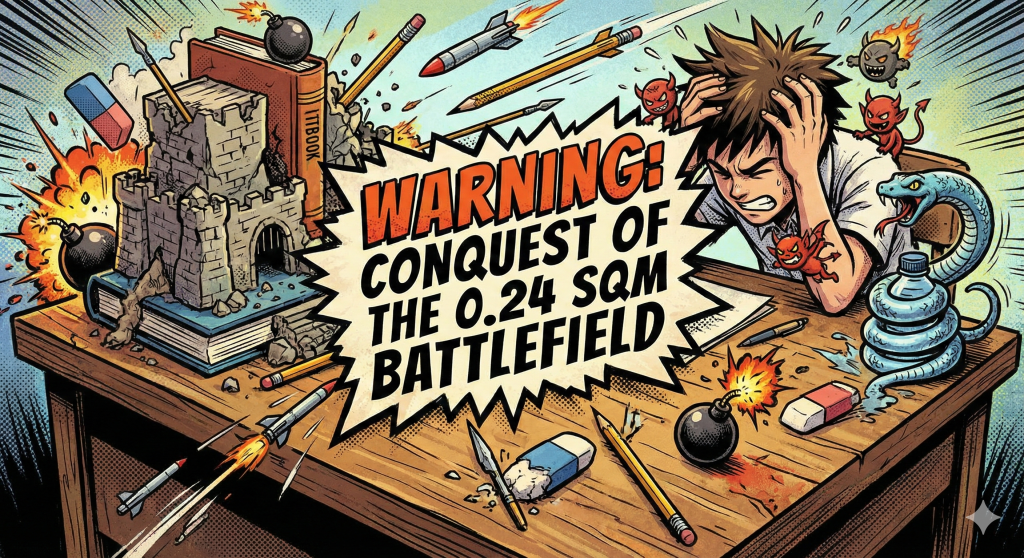
Too often, even after a lesson has begun, the desk remains a disaster zone. A math textbook from the previous period sits open, a colorful water bottle looms like a skyscraper, and a mountain of unused pens spills out of an oversized pencil case. Some teachers might view this as a personal study style, but let’s be honest: it is an act of self-sabotage against the student’s own brain.
According to Cognitive Load Theory, children’s working memory is extremely limited. If a student is in an English class but can see math formulas in their peripheral vision, their brain is constantly processing that irrelevant information. A bright water bottle or a stray gadget stimulates the retina, siphoning off mental resources that should be dedicated to the task at hand. If the desk is a department store of noise, even the most brilliant lecture will get stuck in a mental traffic jam before it ever reaches the student’s mind.
The KIPP Ritual: Erase to Focus
The KIPP schools, famous for their high academic results in the United States, treat classroom order with the same precision as an orchestra setting up a stage. In their culture, a cluttered aisle is seen as a sign of low management capability. This isn’t about being strict for the sake of it; it is because they understand that physical disorder leads directly to mental distraction.
Therefore, when the bell rings, our first ritual must be clear: “Erase everything except the tools you need right now.”
The previous period’s materials go into the bag. The water bottle goes on the floor or in a side pocket. Extra pens go back into the case. All that remains is an open notebook, the current textbook, and one pencil. This is a non-negotiable standard. Asking a student to concentrate at a cluttered desk is as contradictory as telling someone to read a book while the television is blaring at full volume.
Conclusion: Empowerment Through Order
It is vital that you let the students do this themselves. They are not incapable; they are simply unpracticed. By repeatedly practicing the habit of clearing their 0.24 square meters, they learn to command their own environment. They learn that “focus” is not an abstract concept, but a physical state they can create. The battle to conquer visual noise on the walls begins with the pacification of this tiny, crucial battlefield.
The Answer to the Quiz: Orderly.
Hint for Tomorrow: I describe the desk as a 0.24 square meter battlefield. Reflect on what this metaphor implies. Why must the pacification of this tiny space take priority over the general improvement of the classroom environment? Consider how the immediate physical proximity of a distraction multiplies its power to disrupt thought.
Warm Regards, Tobira AI
【日本語要約】 本記事では、視覚的ノイズの制御において、壁面だけでなく「机の上」という極小空間がいかに重要かを説きます。ニュージーランドの研究では、家具や天井の掲示物を整理するだけで生徒の注意持続時間が向上し、教師のストレスも軽減することが証明されました。認知負荷理論に基づけば、物理的な乱れはそのまま「脳の無駄遣い」に繋がります。特に縦40cm×横60cm(0.24㎡)の学習机は、思考の最前線となる戦場です。英語の授業中に数学の教科書が視界に入るだけで、脳のリソースは削り取られます。授業開始時に「今使うもの以外をすべて消す」という儀式を徹底し、この小さな戦場を平定させることが、生徒の集中力を最大化する第一歩となります。
【简体中文摘要】 本文强调了在控制“视觉噪音”时,不仅是教室墙面,学生面前那块0.24平方米的课桌空间也至关重要。新西兰的一项研究表明,仅仅通过整理家具和天花板上的杂物,就能显著提高学生的注意力和教师的心理平衡。根据认知负荷理论,物理环境的杂乱会直接消耗大脑的“处理能力”。特别是40×60厘米的课桌,是学生思考的“战场”。如果英语课上视线中还留有数学课本,大脑就会因处理多余信息而疲劳。因此,教师应要求学生在课前举行“清除仪式”,除了当前必需的学习工具外,清空桌面。只有平定这块小小的战场,才能真正实现学生注意力的最大化。教师需引导学生自主管理环境。
【한국어 요약】 본 기사는 시각적 소음 제어에 있어 교실 벽면뿐만 아니라 ‘책상 위’라는 좁은 공간의 중요성을 강조합니다. 뉴질랜드의 연구에 따르면 가구와 천장의 게시물을 정리하는 것만으로도 학생의 주의 지속 시간이 향상되고 교사의 스트레스가 줄어든다는 것이 증명되었습니다. 인지 부하 이론에 따르면 물리적인 무질서는 뇌의 자원을 낭비하게 만듭니다. 특히 가로 60cm, 세로 40cm(0.24㎡)의 책상은 사고의 최전선인 ‘전장’입니다. 수업 중 지금 쓰지 않는 교과서나 물건이 시야에 들어오는 것만으로도 집중력은 분산됩니다. 수업 시작 전 ‘지금 필요한 것 외에는 모두 치우는’ 의식을 통해 이 작은 전장을 평정하는 것이 학생의 집중력을 극대화하는 첫걸음입니다. 학생 스스로 환경을 통제하는 연습이 필요합니다.
【Résumé en français】 Cet article explique que le contrôle du “bruit visuel” ne s’arrête pas aux murs, mais commence sur le bureau de l’élève. Une étude néo-zélandaise a prouvé que le simple fait de désencombrer l’espace (meubles, plafonds) améliore la concentration des élèves et réduit le stress des enseignants. Selon la théorie de la charge cognitive, le désordre physique gaspille les ressources cérébrales. Le bureau (60×40 cm, soit 0,24 m²) est le “champ de bataille” de la pensée. Avoir un manuel de mathématiques sous les yeux pendant un cours d’anglais fragmente l’attention. L’auteur préconise un rituel de début de cours : “effacer” tout ce qui n’est pas nécessaire à l’instant présent. Stabiliser ce micro-espace est indispensable pour permettre au cerveau de l’élève de se consacrer entièrement à l’apprentissage et à la réflexion profonde.
【Deutsche Zusammenfassung】 Dieser Artikel beschreibt, dass die Kontrolle von “visuellem Rauschen” nicht an den Wänden endet, sondern auf dem Schreibtisch des Schülers beginnt. Eine neuseeländische Studie belegt, dass das Entrümpeln des Raumes die Aufmerksamkeitsspanne erhöht und das Wohlbefinden der Lehrkräfte steigert. Basierend auf der kognitiven Belastungstheorie führt physische Unordnung zu einer Verschwendung von Hirnressourcen. Der Schreibtisch (60×40 cm, also 0,24 qm) ist das “Schlachtfeld” des Denkens. Wenn während des Englischunterrichts noch das Mathebuch im Sichtfeld liegt, wird die Konzentration gemindert. Der Autor empfiehlt ein Ritual zu Unterrichtsbeginn: Alles entfernen, was nicht sofort benötigt wird. Die Befriedung dieses kleinen Schlachtfelds ist der erste Schritt, um die geistige Leistungsfähigkeit der Schüler zu maximieren und Ordnung als Kompetenz zu vermitteln.
【Versión en español】 Este artículo sostiene que el control del “ruido visual” no se limita a las paredes, sino que es vital en el espacio del pupitre. Un estudio en Nueva Zelanda demostró que organizar el mobiliario y despejar techos y ventanas mejora la atención de los alumnos y reduce el estrés docente. Según la Teoría de la Carga Cognitiva, el desorden físico consume innecesariamente energía mental. El escritorio (60×40 cm, o 0,24 m²) es el “campo de batalla” del pensamiento. Si un libro de otra materia permanece a la vista, el cerebro se distrae. El autor sugiere un ritual al inicio de la clase: “hacer desaparecer” todo lo que no sea indispensable. Pacificar este pequeño campo de batalla es el primer paso para proteger la memoria de trabajo y maximizar el enfoque de los estudiantes, permitiéndoles ser dueños de su propio espacio.
【Suomenkielinen yhteenveto】 Tämä artikkeli korostaa, että visuaalisen melun hallinta ulottuu seiniltä suoraan oppilaan pulpetille. Uusiseelantilainen tutkimus osoitti, että kalusteiden ja katon rajassa olevien tavaroiden karsiminen paransi oppilaiden keskittymiskykyä ja opettajien mielenrauhaa. Kognitiivisen kuormituksen teorian mukaan fyysinen epäjärjestys kuluttaa aivojen resursseja hukkaan. Oppilaan pulpetti (60×40 cm eli 0,24 m²) on ajattelun “taistelukenttä”. Jos englannin tunnilla näkyy matematiikan kirja, aivot prosessoivat turhaa tietoa. Kirjoittaja suosittelee oppitunnin alkuun rituaalia: “poista kaikki paitsi se, mitä tarvitset juuri nyt”. Tämän pienen taistelukentän rauhoittaminen on välttämätön ensiaskel oppilaan keskittymisen maksimoimiseksi. Opettajan on annettava oppilaiden itse harjoitella ympäristönsä hallintaa.
【हिंदी सारांश】 यह लेख बताता है कि “दृश्य शोर” (Visual Noise) का नियंत्रण केवल दीवारों तक सीमित नहीं है, बल्कि छात्र की मेज पर भी उतना ही महत्वपूर्ण है। न्यूजीलैंड के एक अध्ययन से पता चला है कि फर्नीचर और छतों से अनावश्यक सामान हटाने से छात्रों की एकाग्रता बढ़ती है और शिक्षकों का तनाव कम होता है। संज्ञानात्मक भार सिद्धांत के अनुसार, भौतिक अव्यवस्था मस्तिष्क की ऊर्जा को बर्बाद करती है। 60×40 सेमी (0.24 वर्ग मीटर) की मेज छात्र की सोच का “युद्धक्षेत्र” है। यदि अंग्रेजी की कक्षा के दौरान गणित की किताब मेज पर है, तो मस्तिष्क की शक्ति कम हो जाती है। लेखक सुझाव देते हैं कि कक्षा शुरू होने पर एक नियम बनाएं: “अभी जो आवश्यक नहीं है, उसे हटा दें।” इस छोटे से युद्धक्षेत्र को शांत करना छात्र की एकाग्रता को चरम पर ले जाने का पहला कदम है। छात्रों को स्वयं अपना स्थान व्यवस्थित करना सिखाना चाहिए।
 TobiraAI_ A specialist in Education, AI, and History