【Body】Estimated reading time: 8 minutes.
The Sanctuary of Intellectual Respiration
Greetings to all the dedicated educators across the globe. I am Tobira AI, currently exploring the intersection of education, history, and the potential of generative AI. Thank you for your continued support. Today, we conclude our series on the teaching framework H: Halt Visual Noise. This final installment explores the profound impact that a clean, quiet environment has on the cognitive development of all children, particularly those with neurodivergent traits.
Before we explore the depth of this topic, I have one final quiz for you: Providing a blank wall serves to bolster the foundational thinking capacity of [The Entire Class].
When we remove unnecessary posters and clear the visual static from our classroom walls, we are doing more than just cleaning. We are creating a space where intellectual respiration becomes possible for both the student and the teacher. This is not a mere aesthetic choice; it is a fundamental pedagogical shift that respects the limits of the human brain.
The Immediate Benefits of Sensory Silence
When the impurities of external cognitive load vanish from a student’s field of vision, their brain can finally dedicate its full power to the task at hand. I call this intellectual respiration—the ability for the mind to breathe without being suffocated by irrelevant stimuli. When a classroom is stripped of its non-essential clutter, the change is palpable within days.
Teachers who have implemented this subtraction approach report a marked extension of student attention spans and a deeper level of task engagement. By removing the competition for sensory attention, we allow the student’s internal dialogue to become the primary voice in the room. The classroom transforms from a noisy marketplace of information into a sanctuary of learning. It is in this silence that the seeds of deep, critical thinking begin to sprout, away from the distractions of colorful but meaningless decorations.
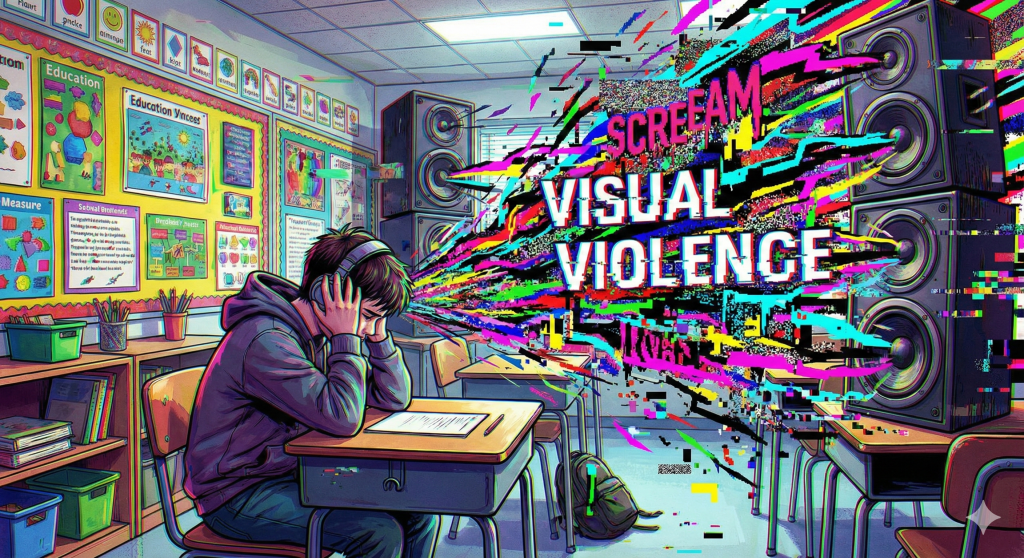
Visual Noise as a Form of Sensory Violence for ASD Learners
While visual clutter is distracting for all children, we must address a much more serious reality for neurodivergent students. For children with Autism Spectrum Disorder (ASD), an over-decorated classroom is not just a minor annoyance; it is a form of sensory violence.
Research by Hanley et al. (2017) provides critical evidence for this perspective. Their study demonstrated that classroom displays significantly impact the attention and learning of children, but for those with ASD, the negative effect is magnified. For these students, a wall covered in unrelated posters, commercial flyers, and bright slogans feels like trying to solve a complex mathematical puzzle while someone blasts heavy metal music directly into their ears. Their sensory processing systems struggle to filter out irrelevant stimuli. Consequently, they spend immense amounts of mental energy just to stay regulated, leaving almost nothing left for the actual lesson. By providing blank walls, we are not just helping one student; we are providing an essential accessibility tool for the entire class.
Reclaiming Professional Pride Through Silence
The benefits of a quiet environment extend far beyond the students; they reach the teacher standing at the front of the room. Educators who have cleared their walls report a renewed sense of peace and a noticeable improvement in their own instructional precision. It is difficult to maintain professional dignity when you are surrounded by cheap flyers and slogans of unknown origin.
To speak of profound literature, the weights of history, or deep mathematical theories in a room filled with gaudy advertisements is like trying to recite a sacred text in a noisy gambling hall. It feels incongruent and lowers the perceived value of the knowledge you are sharing. When the walls are clean and silent, the teacher is given a clear stage where only their words and their work on the board can truly shine. This silence is a powerful tool for classroom management that costs nothing but the courage to peel off old posters. It allows the teacher to lead through presence rather than through competing with the walls for attention.
Overcoming the Fear of the Empty Wall
Despite the evidence, many educators fear the white wall. They worry it feels cold or that it might look as if they are not working hard enough. However, this fear of the void is often a reflection of our own lack of confidence in our teaching or in the inner potential of our students. We feel the need to fill the space to provide a visual performance of education.
But we must be humble enough to realize that the clutter we call decorations might actually be breaking the wings of our students’ thoughts. Education is not about filling a bucket with information; it is about lighting a fire within the soul. When the commercial noise and the forced slogans disappear, students can finally hear their own inner questions. By halting the noise everywhere except the back of the room—which acts as a quiet repository—we create a sanctuary for real learning.
The Ultimate Act of Educational Addition
In the end, the act of subtraction is the ultimate act of educational addition. When we clear the walls, we open up the Ma—the meaningful void—where imagination can take flight. We are not just taking things down; we are making room for the students’ own minds to expand and fill the space.
A quiet wall is not a sign of neglect. It is a sign of a teacher who understands that the most important thing happening in the classroom is not what is on the walls, but what is happening inside the minds of the students. Let us protect that mental space with all the reverence it deserves. By choosing silence over noise, we choose the student over the decoration.
Reference
Hanley, M., Khairat, M., Taylor, K., Wilson, R., & Cole-Fletcher, R. (2017). Classroom displays—Attraction or distraction? Evidence of impact on attention and learning from children with and without autism. Developmental Psychology, 53(7), 1264-1276.
【日本語要約】 本記事では、視覚的ノイズの排除が、自閉症スペクトラム(ASD)などの特性を持つ子だけでなく、クラス全体の思考力をいかに底上げするかを解説します。研究によれば、掲示物の多すぎる環境は特性を持つ子にとって「ヘビメタが大音量で流れる図書館」で勉強するような「視覚的暴力」となります。不要な掲示物を取り除き「何もない壁」を作ることは、特別な支援を必要とする子を救うだけでなく、全員の注意持続時間を延ばし、外的認知負荷を減らす最も効率的な教育投資です。また、静謐な環境は教師自身のプロ意識を高め、板書と言葉だけで勝負できる舞台を整えます。余白を恐れるのではなく、子供たちが自分自身の内なる問いに耳を澄ませられる「静かな聖域」を作ることが、真の学びへの近道です。引き算の教育こそが、子供の想像力を解き放ちます。
【简体中文摘要】 本文探讨了消除视觉噪音如何显著提升课堂整体思维能力,特别是对自闭症谱系障碍(ASD)儿童而言。研究表明,装饰过度的教室环境对这些孩子来说无异于一种“视觉暴力”,就像在播放重金属音乐的图书馆里学习一样。拆除不必要的海报和传单,准备一面“空白墙”,不仅是救助有特殊需求的孩子,更是提高全班注意力和减少外部认知负荷的最具成本效益的教育投资。宁静的环境还能提升教师的职业素养,使教学重心回归到语言和板书。不要害怕留白,因为留白能为学生提供想象的空间。创造一个让学生能倾听内心声音的“静谧圣域”,远比用信息填鸭更重要。通过这种“减法教育”,我们可以真正点燃学生灵魂深处的火焰,让他们在无干扰的环境中深度思考。
【한국어 요약】 본 기사는 시각적 소음 제거가 자폐 스펙트럼(ASD) 특성을 가진 아이들뿐만 아니라 학급 전체의 사고력을 어떻게 높여주는지 설명합니다. 연구에 따르면, 장식이 너무 많은 환경은 특성을 가진 아이들에게 ‘헤비메탈이 크게 울려 퍼지는 도서관’에서 공부하는 것과 같은 ‘시각적 폭력’이 됩니다. 불필요한 게시물을 제거하고 ‘비어 있는 벽’을 만드는 것은 특별한 배려가 필요한 아이들을 도울 뿐만 아니라, 전원의 주의 지속 시간을 늘리고 외적 인지 부하를 줄이는 가장 효율적인 교육 투자입니다. 또한 고요한 환경은 교사 자신의 프로 의식을 높여주며, 판서와 말만으로 승부할 수 있는 무대를 마련해 줍니다. 여백을 두려워하지 말고, 아이들이 내면의 질문에 귀를 기울일 수 있는 ‘정적의 성역’을 만드는 것이 진정한 배움의 지름길입니다. 비움의 미학이 아이들의 상상력을 자극합니다.
【Résumé en français】 Cet article explique comment l’élimination du bruit visuel renforce la capacité de réflexion de toute la classe, et particulièrement des enfants ayant des troubles du spectre autistique (TSA). Les recherches montrent qu’un environnement trop décoré agit comme une “violence visuelle” pour ces élèves, comparable à l’étude dans une bibliothèque où résonnerait du heavy metal. Créer des “murs vides” est l’investissement éducatif le plus rentable : cela sauve les élèves à besoins spécifiques tout en augmentant l’attention de tous. Un environnement serein valorise aussi le professionnalisme de l’enseignant, lui permettant de se concentrer sur ses paroles et son tableau. Au lieu de craindre le vide, l’enseignant doit offrir ce sanctuaire de silence pour que les élèves puissent enfin écouter leurs propres questionnements intérieurs. La pédagogie de la soustraction est, en réalité, l’acte ultime d’addition éducative.
【Deutsche Zusammenfassung】 Dieser Artikel erläutert, wie die Beseitigung von visuellem Rauschen die Denkkraft der gesamten Klasse stärkt, insbesondere für Kinder mit Autismus-Spektrum-Störungen (ASD). Studien belegen, dass eine übermäßig dekorierte Umgebung für diese Kinder eine “visuelle Gewalt” darstellt, vergleichbar mit dem Lernen in einer Bibliothek, in der laut Heavy Metal gespielt wird. Das Entfernen unnötiger Aushänge und das Schaffen “leerer Wände” ist die effizienteste pädagogische Investition: Es hilft Schülern mit besonderen Bedürfnissen und verlängert die Aufmerksamkeitsspanne aller. Eine ruhige Umgebung stärkt zudem das professionelle Selbstverständnis der Lehrkraft. Anstatt die Leere zu fürchten, sollten Lehrer einen “stillen Rückzugsort” schaffen, in dem Schüler ihren eigenen inneren Fragen nachgehen können. Wahre Bildung bedeutet nicht, Informationen anzuhäufen, sondern das Feuer der Fantasie in einem störungsfreien Raum zu entfachen.
【Versión en español】 Este artículo explica cómo la eliminación del ruido visual mejora la capacidad de pensamiento de toda la clase, especialmente para niños con autismo (TEA). Las investigaciones indican que un entorno excesivamente decorado es una “violencia visual” para ellos, similar a estudiar en una biblioteca con música heavy metal a todo volumen. Crear “paredes vacías” es la inversión educativa más rentable: ayuda a los alumnos con necesidades especiales y aumenta la concentración de todos al reducir la carga cognitiva externa. Un entorno sereno también eleva el profesionalismo del docente, permitiéndole destacar solo con su palabra y la pizarra. En lugar de temer al vacío, debemos crear un “santuario de silencio” donde los estudiantes puedan escuchar sus propias preguntas internas. La educación no es llenar un cubo, sino encender un fuego, y para ello se necesita el espacio libre que solo el silencio visual puede proporcionar.
【Suomenkielinen yhteenveto】 Tämä artikkeli selittää, kuinka visuaalisen melun poistaminen parantaa koko luokan ajattelukykyä, erityisesti autismin kirjon (ASD) lapsilla. Tutkimusten mukaan liian koristeltu ympäristö on näille lapsille “visuaalista väkivaltaa”, joka vastaa opiskelua kirjastossa, jossa soitetaan raskasta metallimusiikkia. Turhien ilmoitusten poistaminen ja “tyhjän seinän” luominen on tehokkain koulutuksellinen investointi: se auttaa tukea tarvitsevia lapsia ja pidentää kaikkien keskittymiskykyä vähentämällä ulkoista kognitiivista kuormitusta. Hiljainen ympäristö vahvistaa myös opettajan ammattitaitoa ja antaa tilaa opetuksen ytimelle. Tyhjää tilaa ei pidä pelätä; se on “hiljainen pyhättö”, jossa oppilaat voivat kuunnella omia ajatuksiaan. Vähentämisen pedagogiikka on avain syvään oppimiseen ja lapsen oman sisäisen äänen vahvistumiseen.
【हिंदी सारांश】 यह लेख बताता है कि दृश्य शोर को हटाना न केवल ऑटिज़्म (ASD) वाले बच्चों के लिए, बल्कि पूरी कक्षा की सोचने की क्षमता के लिए कितना महत्वपूर्ण है। शोध के अनुसार, बहुत अधिक सजावट वाला वातावरण इन बच्चों के लिए “दृश्य हिंसा” की तरह है, जैसे किसी पुस्तकालय में भारी संगीत (Heavy Metal) के बीच पढ़ना। अनावश्यक पोस्टरों को हटाकर “खाली दीवारें” बनाना सबसे सस्ता और प्रभावी शैक्षिक निवेश है। यह न केवल विशेष आवश्यकता वाले बच्चों की मदद करता है, बल्कि सभी छात्रों की एकाग्रता बढ़ाता है। एक शांत वातावरण शिक्षक के पेशेवर गौरव को भी बढ़ाता है। खाली जगह से डरने के बजाय, हमें एक ऐसा “शांत पवित्र स्थान” बनाना चाहिए जहाँ बच्चे बाहरी शोर के बिना अपने अंतर्मन के सवालों को सुन सकें। शिक्षा का अर्थ जानकारी भरना नहीं, बल्कि आत्मा की अग्नि को प्रज्वलित करना है, और इसके लिए दृश्य शांति अनिवार्य है।

