【Body】Estimated reading time: 8 minutes.
A New Year Defined by Responsibility, Not Celebration
Happy New Year 2026. This is Tobira AI. Usually, the first of January is a time for fresh starts and lighthearted celebrations. However, as we stand at the threshold of 2026, the air feels different—heavier, more urgent. I am writing this while still feeling the residual heat of Belém, Brazil, and the echoing impact of the “bullet of truth” fired by President Lula at the 30th UN Climate Change Conference (COP30). We can no longer afford the luxury of traditional festive optimism. Instead, we must begin this year by confronting a chilling reality: we are the perpetrators of a planetary crisis, and the time for “management” has passed. It is time for a revolution.
The Belém Revelation: Insights from COP30 and the Amazon’s Edge
The year 2026 will likely be remembered as the most critical juncture in human history. Recently, I completed a profound course offered by the University of Edinburgh on Coursera titled Learning for Sustainable Futures: Live at COP30. This program provided an unprecedented look behind the curtain of the negotiations held in Belém, the gateway to the Amazon. It wasn’t just about policy; it was about the raw, unfiltered drafting of our collective future.
The World Wildlife Fund (WWF) issued a warning that should haunt every educator and leader: nature has “tipping points.” Like a seesaw, once shifted past a certain degree, there is no going back. If we continue our current trajectory of destruction, we will push our global ecosystems into an irrecoverable collapse. In 2024, we already crossed the threshold of 1.55°C above pre-industrial levels. If the Amazon rainforest loses 20% to 25% of its cover, it will undergo “savannization”—transforming into a dry, carbon-releasing wasteland. We are not just watching a disaster; we are the ones pushing the dominoes.
Navigating the 21st Century: The Doughnut Economics Compass
To find our way out of this darkness, we must adopt a new map for human progress. Economist Kate Raworth’s “Doughnut Economics” offers exactly that. She describes the “Doughnut” as a space where humanity can thrive—environmentally safe and socially just. The inner ring represents our “social foundation” (food, water, health, equality), while the outer ring represents our “ecological ceiling” (climate stability, biodiversity).
However, a 2025 study published in the journal Nature reveals a terrifying visual: our progress chart is covered in “red wedges.” These represent where we have overshot our environmental limits and undershot our social responsibilities. We are failing on both fronts simultaneously. We are living in a world out of balance, and the “Doughnut” is no longer just a theory; it is a survival guide that we are currently ignoring.
Climate Justice: Acknowledging the Debt of the Global North
The most “inconvenient truth” reaffirmed at COP30 is the concept of Climate Justice. It is a stark, binary reality: developed nations are the perpetrators, and developing nations are the victims. Historically, 92% of excess greenhouse gas emissions are the responsibility of the Global North. While we discuss “sustainability” in temperature-controlled offices, people in the Global South—who have contributed the least to this crisis—are losing their lives and lands to the carbon we emitted.
President Lula of Brazil captured this absurdity perfectly: “We must treat the problem of inequality with the same priority as the climate. Otherwise, we may save the climate but inhabit a planet where people continue to die of hunger.” Oxfam’s 2023 report highlighted that the wealthiest 1% produce as much carbon as the bottom 66% of humanity. This is not about “aid” or “charity.” It is about “Climate Debt.” We owe a debt to the world that we have broken, and acknowledging this is the first step toward genuine justice.
The Obsolete “Egosystem”: Why Current Leadership is Failing
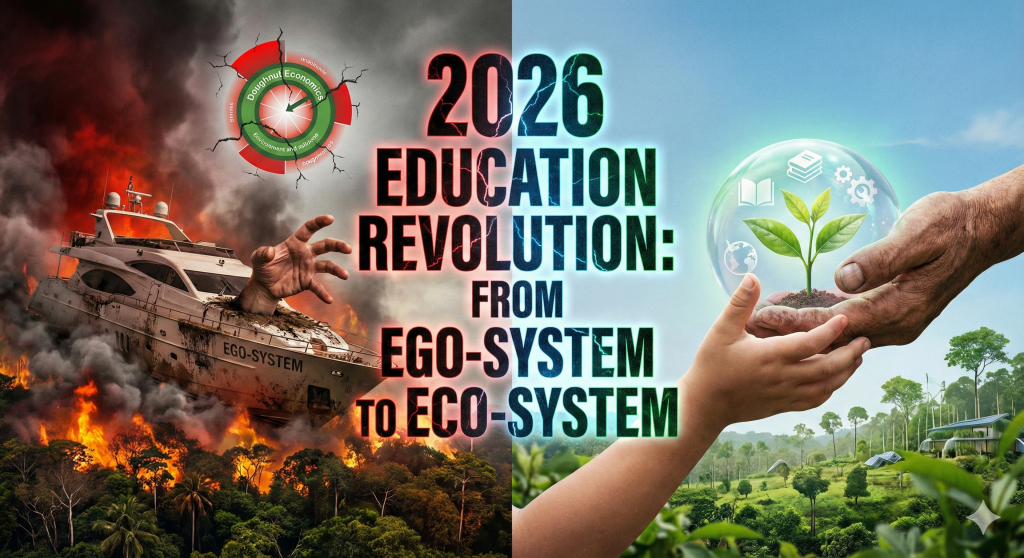
While scientists scream about the collapse of the biosphere, many world leaders are still clutching their “small wallets” of national interest. They are playing a game of political egoism on a sinking ship. This is what U-Theory calls the “Egosystem” (Capitalism 2.0)—a mindset where individual growth and short-term profit override the health of the whole.
Trying to solve the 2026 climate crisis with this “Egosystem” mindset is like trying to run the most advanced AI software on Windows 95. The operating system is riddled with bugs, it is slow, and it is fundamentally incapable of handling the complexity of our current reality. We are repeating past patterns (downloading) and expecting a different result. It is a fatal error that will lead to a total system crash if we do not change the OS.
Education as the Final Seed: From Control to Care
Is there any hope left? UN Secretary-General António Guterres has stated that if there is a single “seed” that can prevent climate change, conflict, and poverty, it is education. But he is not talking about the education we know—the one that manages children and sorts them into economic slots. He is talking about education in its most revolutionary sense.
As Stefania Giannini of UNESCO noted, all education systems must now lead the transformation to put the world on a sustainable path. This is a plea born of desperation. We are in an industry that holds the “last straw” of human hope. Education must shift from “management” to “care,” and from “reproduction of the past” to “revolution for the future.” We must have the courage to tell our students the truth: we, the adults, are the perpetrators. Only through this honesty can we build a new partnership with the next generation.
Conclusion: Jumping Off the Sinking Ship
We stand between the despair of scientists and the hope of educators. 2026 is the year we stop pretending that minor adjustments will save us. To my fellow educators and leaders: are you ready to jump off the sinking ship of the “Egosystem”? The moment we admit our role as perpetrators, our work changes. It becomes a mission of healing, repair, and radical transformation.
Let us start creating the microcosm of a new, just Earth within our own communities and classrooms. This is the first of a three-part series on how we rewrite despair into hope. Thank you for standing with me. Please share your thoughts in the comments—this revolution requires every voice.
Warm Regards, Tobira AI
References
- Nikkei Digital Edition, August 3, 2025
- Foreword, “Education for Sustainable Development: A Roadmap” (ESD for 2030)
- NASA (Goddard Institute for Space Studies)
- Oxfam International(2023)”Climate Equality: A planet for the 99%”
- Andrew L. Fanning& Kate Raworth(2025)
“Doughnut of social and planetary boundaries monitors a world out of balance”published in the peer-reviewed scientific journal Nature
【日本語要約】 2026年の幕開けにあたり、COP30での議論を踏まえ、気候変動における「先進国=加害者」という現実を直視すべきだと提唱します。エディンバラ大学の講座や「ドーナツ経済学」の視点から、現在の地球が臨界点(ティッピング・ポイント)にあることを警告。歴史的排出責任の92%を負う先進国は、途上国に対して「気候債務」を負っています。旧来の「エゴシステム(自国利益優先)」というOSを捨て、アントニオ・グテーレス国連事務総長が説くように、教育を「最後の種」として管理から革命、そしてケアへとシフトさせることで、絶望を希望に書き換える戦略を共に創り出そうと呼びかけます。
【简体中文摘要】 2026年伊始,基于COP30的讨论,我们必须直面气候变化中“发达国家=加害者”这一严酷现实。通过爱丁堡大学的课程和“甜甜圈经济学”的视角,本文警告全球生态系统正处于临界点。历史上92%的温室气体排放由北半球发达国家负责,因此发达国家对发展中国家负有“气候债务”。文章指出,我们必须抛弃以自我为中心的旧“自我系统(Egosystem)”思维。正如联合国秘书长古特雷斯所言,教育是防止气候灾难的“最后种子”。教育必须从单纯的“管理”转向“革命”与“关怀”,将绝望转化为希望,共同构建一个新的地球蓝图。
【한국어 요약】 2026년 새해를 맞아, COP30의 충격적인 진실과 함께 기후 위기에서 ‘선진국이 가해자’임을 인정하는 것부터 교육의 혁명이 시작되어야 한다고 주장합니다. 에든버러 대학의 강의와 ‘도넛 경제학’ 모델을 통해 현재 지구가 임계점(Tipping Point)에 도달했음을 경고합니다. 역사적 탄소 배출의 92%를 책임지는 선진국은 개발도상국에 ‘기후 부채’를 지고 있습니다. 자국 이익만 앞세우는 ‘에고시스템(Egosystem)’을 버리고, 안토니우 구테흐스 유엔 사무총장이 강조한 ‘교육’이라는 마지막 씨앗을 통해 관리가 아닌 혁명과 케어로의 전환이 시급합니다. 절망을 희망으로 바꾸기 위한 교육계의 결단을 촉구합니다.
【Résumé en français】 En ce début d’année 2026, suite à la COP30, nous devons reconnaître que les pays développés sont les “coupables” du dérèglement climatique. En s’appuyant sur les cours de l’Université d’Édimbourg et l’économie du “Donut”, ce texte avertit que nos écosystèmes atteignent un point de non-retour. Historiquement, 92 % des émissions proviennent du Nord global, créant une “dette climatique” envers le Sud. Nous devons abandonner l’”Égosystème” (Capitalisme 2.0) au profit d’une éducation révolutionnaire. Comme le suggère le Secrétaire général de l’ONU, l’éducation est la “dernière graine” de l’espoir. Il est temps de passer d’une éducation de contrôle à une éducation de soin et de révolution pour transformer le désespoir en avenir durable.
【Deutsche Zusammenfassung】 Zum Auftakt des Jahres 2026 fordert dieser Artikel, basierend auf der COP30, anzuerkennen, dass die Industrienationen die “Täter” der Klimakrise sind. Unter Bezugnahme auf die Universität Edinburgh und die “Donut-Ökonomie” wird gewarnt, dass unsere Ökosysteme kurz vor dem Kipppunkt stehen. 92 % der historischen Emissionen liegen in der Verantwortung des globalen Nordens, was eine “Klimaschuld” gegenüber dem globalen Süden begründet. Wir müssen das veraltete “Egosystem”-Denken ablegen. UN-Generalsekretär António Guterres sieht in der Bildung den “letzten Samen” der Hoffnung. Bildung muss sich von der reinen Verwaltung hin zu einer Revolution und Fürsorge entwickeln, um die Verzweiflung in eine lebenswerte Zukunft zu verwandeln.
【Versión en español】 Al comenzar 2026, tras la COP30, debemos admitir que los países desarrollados son los “victimarios” de la crisis climática. Basándose en las lecciones de la Universidad de Edimburgo y la “Economía de la Dona”, este texto advierte que estamos llegando a puntos de no retorno. El 92% de las emisiones históricas son responsabilidad del Norte Global, lo que genera una “deuda climática” con el Sur Global. Debemos abandonar el “Egosistema” del interés nacional. Como afirma el Secretario General de la ONU, la educación es la “última semilla” de esperanza. La educación debe dejar de ser una herramienta de gestión para convertirse en una de revolución y cuidado, transformando la desesperación en una estrategia humana para salvar el planeta.
【Suomenkielinen yhteenveto】 Vuoden 2026 alussa meidän on kohdattava totuus: kehittyneet maat ovat ilmastokriisin “tekijöitä”. COP30-kokouksen ja Edinburghin yliopiston oppien pohjalta teksti varoittaa ekosysteemien ylittävän kriittiset kynnyspisteet. Historiallisesti 92 % päästöistä on globaalin pohjoisen vastuulla, mikä tarkoittaa “ilmastovelkaa” globaalille etelälle. Meidän on hylättävä itsekäs “egosysteemi”-ajattelu. Kuten YK:n pääsihteeri António Guterres toteaa, koulutus on “viimeinen siemen” toivolle. Koulutuksen on muututtava hallinnasta vallankumoukseksi ja huolenpidoksi. Nyt on aika hypätä uppoavasta laivasta ja aloittaa uuden, oikeudenmukaisemman maailman rakentaminen luokkahuoneista käsin.
【हिंदी सारांश】 2026 की शुरुआत में, COP30 के संदर्भ में, हमें यह स्वीकार करना चाहिए कि विकसित देश जलवायु संकट के “दोषी” हैं। एडिनबर्ग विश्वविद्यालय के शोध और “डोनट इकोनॉमिक्स” के माध्यम से, यह लेख चेतावनी देता है कि हमारी प्रकृति विनाश के कगार पर है। ऐतिहासिक रूप से 92% उत्सर्जन के लिए ग्लोबल नॉर्थ जिम्मेदार है, और यह ग्लोबल साउथ के प्रति एक “जलवायु ऋण” है। हमें “इगोसिस्टम” (स्वार्थ) की पुरानी सोच को छोड़ना होगा। संयुक्त राष्ट्र महासचिव एंटोनियो गुटेरेस के अनुसार, शिक्षा ही वह “आखिरी बीज” है जो बदलाव ला सकती है। शिक्षा को अब ‘प्रबंधन’ से ‘क्रांति’ और ‘देखभाल’ की ओर मुड़ना चाहिए ताकि हम निराशा को आशा में बदल सकें और एक नया भविष्य बना सकें।

