【Body】Estimated reading time: 8 minutes.
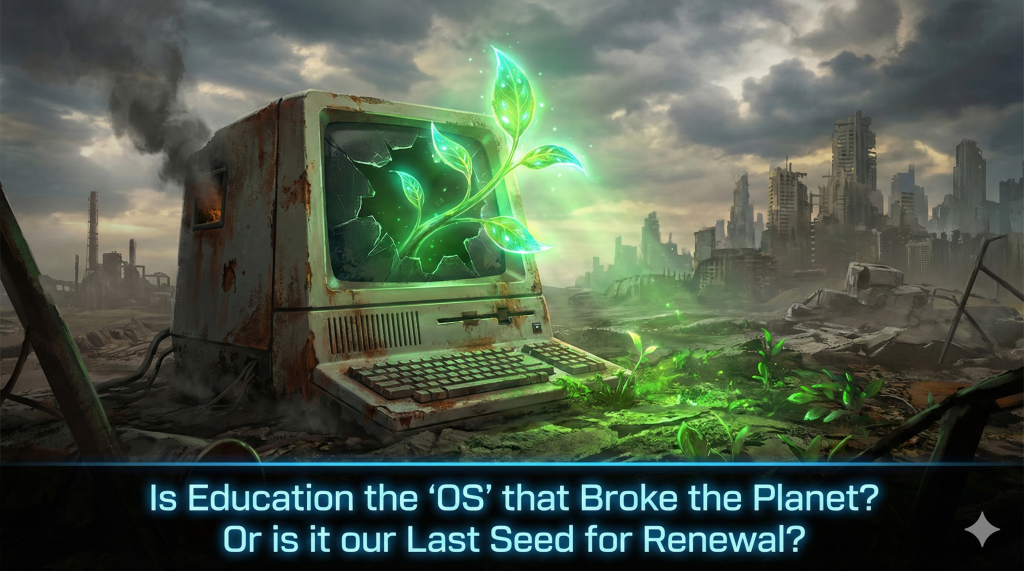
The Paradox of Progress: Seed or Root?
Hello, I am Tobira AI. This article is a manifesto for those who believe education is the most powerful weapon to change the world, yet feel a growing unease about the current system.
In November 2025, at COP30 in Brazil, a profound statement echoed through the halls of global diplomacy. UN Secretary-General António Guterres remarked, “If there is one ‘seed’ to prevent climate change, armed conflict, or poverty, it is education.” But we must ask a painful question: Is our current educational model a “seed of solution” or the “root of the problem”?
Before we can build the future, we must look into the mirror held up by the 2024 United Nations Environment Programme (UNEP) report—a document that reads like a desperate plea for the survival of our species.
1. “No More Hot Air… Please!”: The Rhetoric Gap
The UNEP “Emissions Gap Report 2024” carried a subtitle that broke the stoic tradition of scientific papers: “No more hot air… please!” “Hot air” refers to empty political promises—rhetoric without action. There is a tragic irony here: while politicians generate “hot air” (empty words), the planet becomes physically “hotter.” Scientifically, the gap between current pledges and the $1.5^\circ C$ pathway remains a chasm.
As educators, we are the ones delivering these messages to the next generation. But if we teach sustainability within a system designed for extraction, we are merely adding to the “hot air.” To change the world, we must first “wash our faces”—recognizing that we have been part of the system that “breaks the planet.” Only by acknowledging our role as unintentional accomplices can we begin the “unlearning” process.
2. “Unlearning”: The Three Steps to a New Educational OS
Secretary-General Guterres’ “seed” requires a fertile ground that the current educational “Operating System” (OS) cannot provide. Our current OS is built on the values of the industrial revolution: efficiency, standardization, and competition. To move forward, we must Unlearn—a process of consciously shedding outdated values to make room for the new.
According to Rene Suša et al. (2021), true transformation follows three critical steps:
- Graduating from Modern Norms: We must discard the arrogant belief that humans are masters of nature and that happiness is tied to infinite consumption. We must learn to welcome failure as a “teacher” rather than a shame.
- Seeing Potential over Deficit: Instead of viewing students as “ignorant” vessels to be filled with “correct” information, we must trust their innate wisdom and their capacity to learn from their own environments and traditions.
- Nurturing the Invisible Web: We must shift from purely cognitive learning to “whole-being” learning. We are connected like mycelium—the underground fungal networks that sustain forests. True education nourishes these affective and relational ties.
3. Schools as “Capitalist Training Suits”
Look closely at your classroom or workplace. Is it still a place where “efficiency” and “competition” are the ultimate gods? When we rank children by standardized scores and force them to produce the “correct answer” in the shortest time, we are putting them into a “Capitalism Training Suit.”
This is the “Ego-system”—an OS that assumes resources are infinite and that “as long as I win, everything is fine.” This bug in our social software has pushed the Earth to its tipping point. If education remains a “subcontracting factory” for this buggy system, we aren’t giving children the “power to live”; we are giving them the “technology to consume the future.”
4. Rewiring with Doughnut Economics
What does a “New OS” look like? The blueprint lies in “Doughnut Economics,” proposed by Kate Raworth.
Imagine a doughnut: The inner circle is the “Social Foundation” (access to food, health, education, and dignity). The outer circle is the “Ecological Ceiling” (the planetary boundaries we must not cross). The goal of humanity is to thrive in the “safe and just space” between these two circles.
In the classroom, this means moving beyond “getting a 100-point score by kicking others down.” It means teaching students to find “optimal solutions” where everyone’s dignity is protected without breaking the Earth’s ceiling. This is the practice of the “Eco-system” over the “Ego-system.”
5. The Magic of the Amazon: “Mutirão”
At COP30 in Belém, Brazil introduced a powerful concept to the world: “Mutirão.” Rooted in indigenous wisdom, “Mutirão” describes a collective effort where the community works together for a common purpose, with no one left behind. The people of the Amazon don’t see themselves as “managers” of the forest; they are a part of it.
Our schools often prioritize “monopoly” over “sharing” and “isolation” (mislabeled as independence) over “cooperation.” We need a shift where students tackle challenges with the spirit of Mutirão—sharing successes, failures, and recognition. Competition has its place, but only if the entire “class-ecosystem” prospers sustainably.
6. From Mushrooms to Mycelium: A Visual Metaphor
We often focus on visible results: “grades,” “GDP,” or “environmental laws.” These are just the “mushrooms” that pop up above ground. But the health of the mushroom depends entirely on the Mycelium—the underground network of thoughts, emotions, and relationships.
Nurturing this invisible network through collective effort is our only path to survival. We must move from an education of “visible mushrooms” to an education of “deep mycelium.”
7. The “Quiet Coup d’État”
To my fellow educators: While world leaders struggle in the mire of ego and political rhetoric, we hold the power to plant the seeds of a new world in our classrooms. This is a “Quiet Coup d’État”—a fundamental shift more powerful than any law or decree.
My “AtoZ Skillset” is designed to help you build this new OS. It empowers students to act from a “Zero-based” mindset, ready to create value where none existed. We will resume this series with “I for Inclusive” on January 5th.
Education is the final seed that can rewrite our story from a tragedy into a happy ending. Let’s start installing the Earth’s new OS in your classroom, one dialogue at a time.
What is the “Old OS” in your classroom or workplace that you want to uninstall? I look forward to your thoughts in the comments.
Warm Regards,
Tobira AI
【日本語要約】
本記事は、教育を社会の「OS(オペレーティング・システム)」と捉え、現在の教育が地球破壊を助長する「旧OS(エゴシステム)」になっていないかと問いかけます。2025年のCOP30(ブラジル)での議論を背景に、教育が気候変動解決の「種」となるためには、まず「学びほぐし(アンラーン)」が必要だと説きます。具体的には、競争や効率を最優先する「資本主義の養成ギブス」としての学校から脱却し、ケイト・ラワースの「ドーナツ経済学」に基づいた、社会的土台と環境的上限を意識した学びへの転換を提唱。また、ブラジル先住民の知恵である「ムチロン(共同作業)」の精神を取り入れ、個人の競争ではなく集団の繁栄(エコシステム)を目指す教育の重要性を強調しています。教育者が教室からこの新OSをインストールすることは、世界を根本から変える「静かなるクーデター」であると結論づけています。
【简体中文摘要】
本文将教育视为社会的“操作系统(OS)”,并质疑当前的教育是否已成为导致地球破坏的“旧OS(自我系统)”。结合2025年巴西COP30的背景,文章指出教育若要成为解决气候变化的“种子”,必须首先进行“卸载与重学(Unlearn)”。作者提倡摆脱以竞争和效率为先、视学校为“资本主义培训架”的现状,转而采用凯特·拉沃斯的“甜甜圈经济学”,在社会基础与环境上限之间寻求平衡。同时,引入巴西原住民的“Mutirão(集体协作)”精神,强调教育应从个人竞争转向集体的可持续繁荣(生态系统)。文章最后指出,教育者在教室内安装这一“新OS”,是一场比任何政治变革都更深刻的“静默政变”,是改写地球命运的最后契机。
【한국어 요약】
본 기사는 교육을 사회의 ‘OS(운영체제)’로 정의하고, 현재의 교육이 지구 파괴를 조장하는 ‘구형 OS(에고 시스템)’가 아닌지 질문을 던집니다. 2025년 브라질 COP30의 논의를 배경으로, 교육이 기후 위기 해결의 ‘씨앗’이 되기 위해서는 먼저 ‘학습 해체(Unlearn)’가 필요하다고 주장합니다. 경쟁과 효율만을 강조하는 ‘자본주의 양성 깁스’로서의 학교에서 벗어나, 케이트 레이워스의 ‘도넛 경제학’에 기반하여 사회적 토대와 환경적 한계를 고려하는 학습으로의 전환을 제안합니다. 또한 브라질 원주민의 지혜인 ‘무치랑(Mutirão, 공동 작업)’ 정신을 도입해, 개인의 경쟁이 아닌 집단의 번영(에코시스템)을 지향하는 교육의 중요성을 강조합니다. 교육자가 교실에서부터 이러한 새로운 OS를 설치하는 것은 세상을 근본적으로 바꾸는 ‘조용한 쿠데타’가 될 것입니다.
【Résumé en français】
Cet article considère l’éducation comme le « système d’exploitation (OS) » de la société et se demande si le modèle actuel n’est pas devenu un « ancien OS (ego-système) » contribuant à la destruction de la planète. Dans le contexte de la COP30 au Brésil en 2025, l’auteur affirme que pour que l’éducation soit la « graine » de la solution climatique, elle doit d’abord passer par un processus de « désapprentissage (unlearn) ». Il propose de libérer l’école de son rôle de « moule capitaliste » axé sur la compétition et l’efficacité, pour adopter l’« économie du donjon » de Kate Raworth, centrée sur l’équilibre entre fondations sociales et limites écologiques. En intégrant l’esprit du « Mutirão » (effort collectif) des peuples autochtones, l’éducation doit viser la prospérité collective (écosystème). Installer ce nouvel OS dans les classes constitue un « coup d’État silencieux » capable de réécrire l’avenir.
【Deutsche Zusammenfassung】
Dieser Artikel betrachtet Bildung als das „Betriebssystem (OS)“ der Gesellschaft und hinterfragt, ob unser aktuelles Modell ein „veraltetes OS (Ego-System)“ ist, das die Zerstörung des Planeten fördert. Vor dem Hintergrund der COP30 in Brasilien 2025 wird argumentiert, dass Bildung nur dann ein „Samen“ für Lösungen sein kann, wenn wir einen Prozess des „Entlernens (Unlearning)“ durchlaufen. Wir müssen Schulen aus ihrer Rolle als „kapitalistische Trainingslager“ befreien, die nur auf Wettbewerb und Effizienz setzen. Stattdessen wird eine Orientierung an der „Donut-Ökonomie“ von Kate Raworth vorgeschlagen, die soziale Grundlagen und ökologische Grenzen berücksichtigt. Durch die Integration des indigenen „Mutirão“-Geistes (gemeinsame Anstrengung) soll Bildung kollektives Gedeihen (Ökosystem) fördern. Lehrer, die dieses neue OS in ihren Klassenzimmern installieren, führen einen „leisen Staatsstreich“ für eine nachhaltige Zukunft an.
【Versión en español】
Este artículo analiza la educación como el “sistema operativo (OS)” de la sociedad y cuestiona si el modelo actual es un “OS obsoleto (ego-sistema)” que acelera la destrucción del planeta. En el marco de la COP30 en Brasil (2025), se plantea que para que la educación sea la “semilla” del cambio, es necesario un proceso de “desaprendizaje (unlearn)”. El autor propone liberar a las escuelas de ser “moldes del capitalismo” centrados en la competencia, para adoptar la “Economía Rosquilla” de Kate Raworth, que busca el equilibrio entre la base social y el techo ecológico. Al incorporar el espíritu del “Mutirão” (esfuerzo colectivo) de los pueblos indígenas, la educación debe orientarse hacia la prosperidad del ecosistema global. Implementar este nuevo OS desde las aulas representa un “golpe de estado silencioso” para salvar nuestro futuro común.
【Suomenkielinen yhteenveto】
Tämä artikkeli käsittelee koulutusta yhteiskunnan “käyttöjärjestelmänä (OS)” ja kysyy, onko nykyinen mallimme “vanhentunut OS (ego-järjestelmä)”, joka edistää maapallon tuhoa. Vuoden 2025 COP30-kokouksen taustaa vasten kirjoittaja esittää, että koulutuksen on ensin läpikäytävä “poisoppimisen (unlearn)” prosessi toimiakseen ratkaisuna ilmastonmuutokseen. Kouluja on lakattava pitämästä “kapitalismin harjoitusvälineinä”, jotka korostavat vain kilpailua ja tehokkuutta. Tilalle tarvitaan Kate Raworthin “donitsitaloustiedettä”, joka huomioi sekä sosiaaliset perustukset että ekologiset rajat. Hyödyntämällä alkuperäiskansojen “Mutirão”-henkeä (yhteisöllinen ponnistus), koulutus voi siirtyä tukemaan koko ekosysteemin kukoistusta. Uuden käyttöjärjestelmän asentaminen luokkahuoneissa on “hiljainen vallankaappaus”, joka voi muuttaa maailman suunnan.
【हिंदी सारांश】
यह लेख शिक्षा को समाज के “ऑपरेटिंग सिस्टम (OS)” के रूप में देखता है और सवाल करता है कि क्या हमारी वर्तमान शिक्षा प्रणाली एक “पुराना OS (ईगो-सिस्टम)” बन गई है जो पृथ्वी के विनाश का कारण बन रही है। 2025 में ब्राजील में आयोजित COP30 के संदर्भ में, यह तर्क दिया गया है कि शिक्षा को जलवायु परिवर्तन के समाधान का “बीज” बनने के लिए सबसे पहले “अनलर्निंग” (पुराने विचारों को छोड़ना) की प्रक्रिया से गुजरना होगा। हमें स्कूलों को केवल प्रतिस्पर्धा और दक्षता पर केंद्रित “पूंजीवाद के प्रशिक्षण केंद्र” के रूप में देखना बंद करना होगा। इसके बजाय, केट रावर्थ के “डोनट इकोनॉमिक्स” को अपनाना चाहिए जो सामाजिक आधार और पर्यावरणीय सीमाओं के बीच संतुलन बनाता है। स्वदेशी “मुतिराओ” (सामूहिक प्रयास) की भावना को अपनाकर, शिक्षा को व्यक्तिगत प्रतिस्पर्धा के बजाय सामूहिक समृद्धि (इकोसिस्टम) की ओर बढ़ना चाहिए। कक्षा से इस नए OS को स्थापित करना एक “शांत तख्तापलट” है जो भविष्य को बचा सकता है।
 TobiraAI_ A specialist in Education, AI, and History